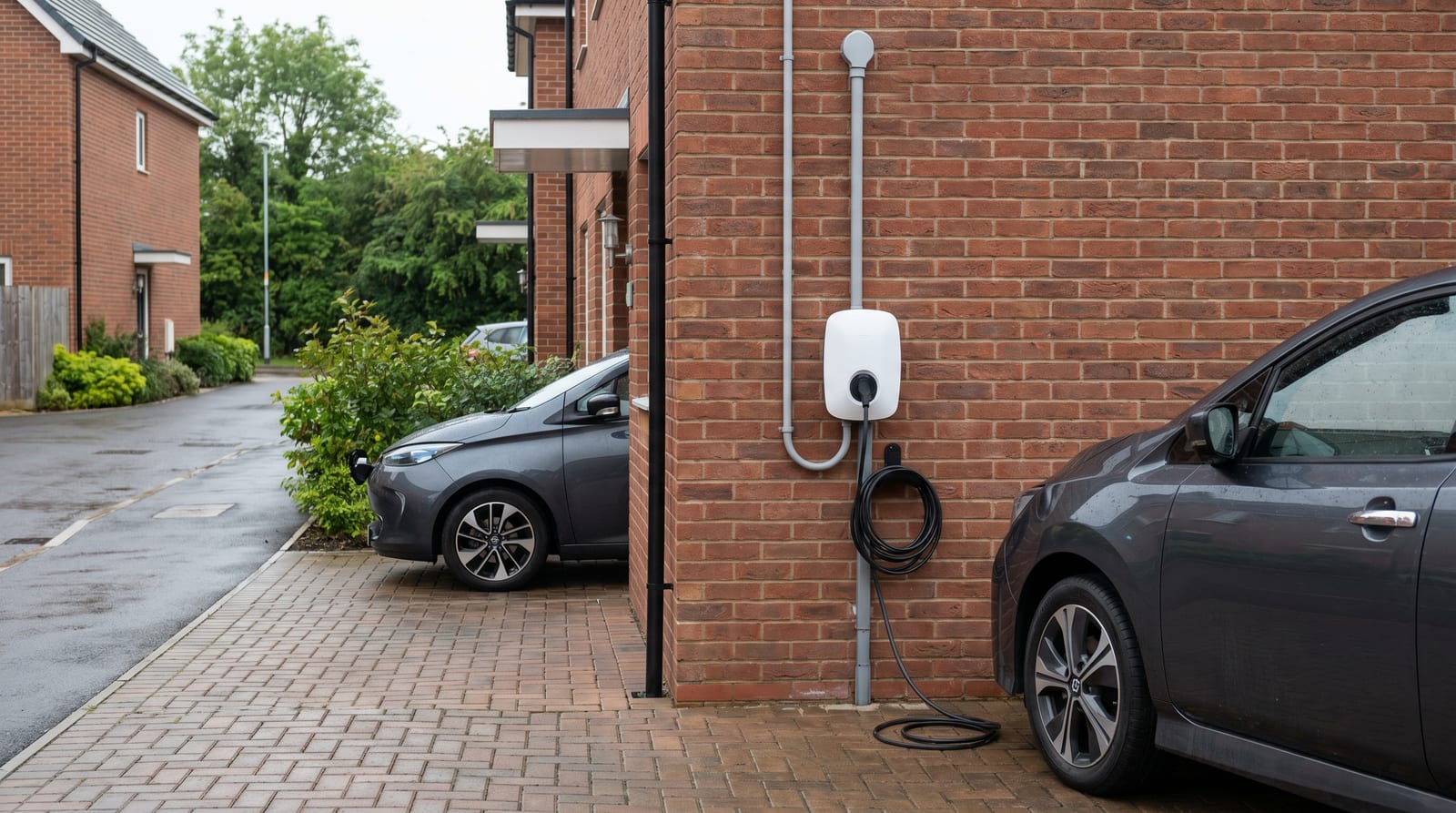
Installing an EV charger at home costs between £900 and £2,500 for most UK properties. The figure depends on your charger choice, your existing electrical supply, and the distance from your consumer unit to the charging position. This guide explains the cost drivers and how to get the right charger for your home.
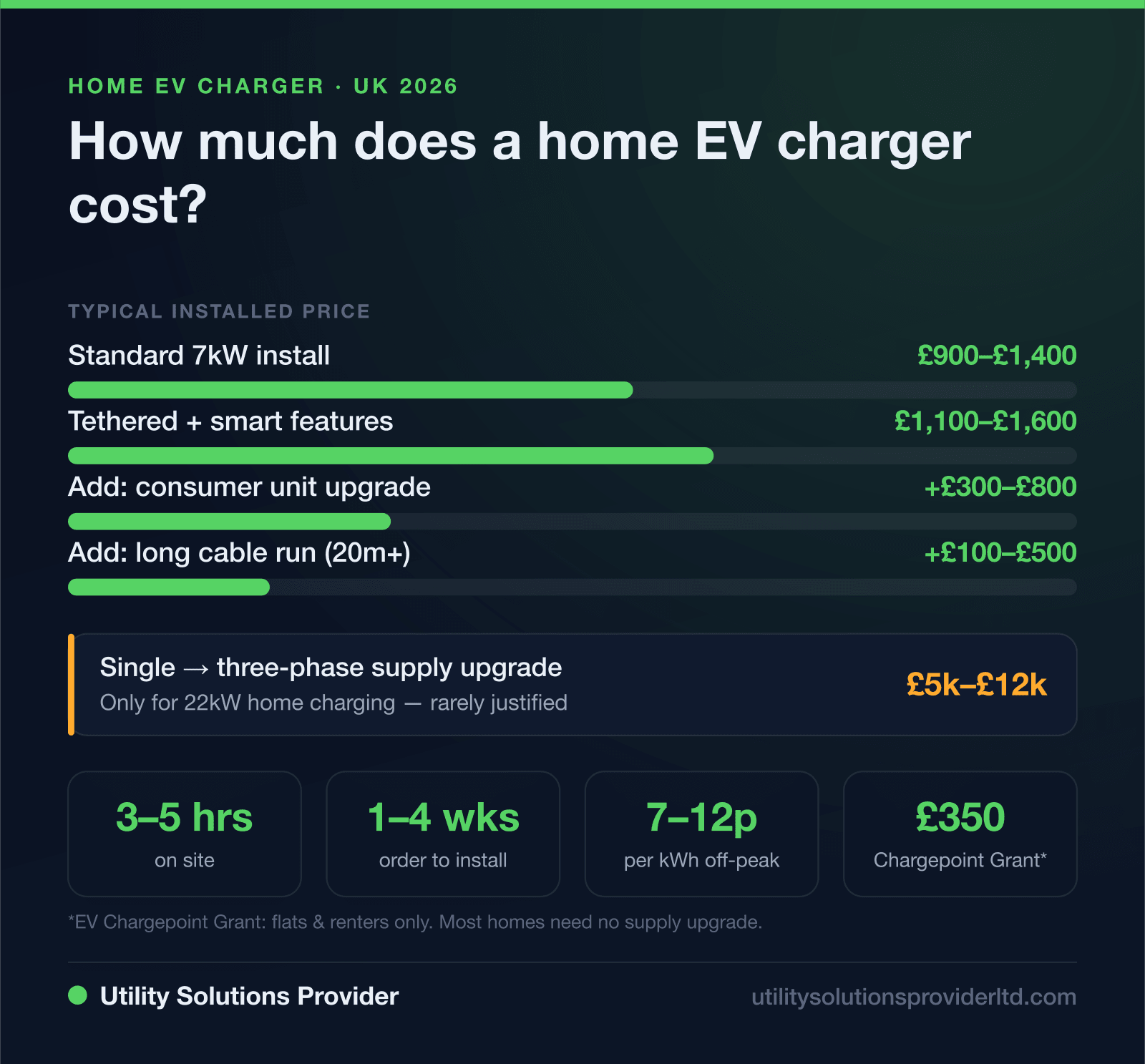
Typical installed prices for a home EV charger in the UK, 2026.
A Standard Home Installation
A typical home EV charger installation involves:
A 7kW single-phase charger mounted on an external wall or pedestal.
A dedicated circuit from the consumer unit (fuse box) to the charger, protected by a Type A or Type B RCBO.
Earthing provision, often using a CT clamp on the incoming supply for PME fault protection.
Commissioning and notification to the DNO.
On a property with a modern consumer unit, an accessible electrical supply, and a charger position within 10 metres of the fuse box, the standard installation cost in 2026 is £900 to £1,400.
What Drives the Price
Six factors push the price up or down.
One. Charger choice. Basic untethered chargers start at around £550 equipment cost. Tethered chargers with smart features run £700 to £950. Premium chargers with additional features (solar integration, vehicle-to-home) run £1,000 to £1,800.
Two. Distance from consumer unit. Charger positions within 10 metres of the CU are quick to cable. Positions 20 metres or more require longer cable runs, potentially with trenching or core drilling, adding £100 to £500.
Three. Consumer unit condition. Older consumer units may need upgrading to meet current regulations. A consumer unit replacement adds £300 to £800.
Four. Earthing arrangements. PME supplies (the most common in the UK) need specific earthing provisions for EV chargers. Modern chargers include CT clamp protection, which is the standard approach. Some homes with TT supplies need an earth rod installation.
Five. Route complexity. Running cable through a loft space, under floorboards, or along an exterior wall is straightforward. Running under a driveway or through a listed building’s masonry adds significant cost.
Six. Single-phase vs three-phase. Single-phase 7kW is standard. Three-phase 22kW chargers require a three-phase supply, which many UK homes do not have.
Three-Phase Upgrades
Most UK homes have a single-phase electrical supply, which limits a home charger to 7kW. For faster home charging, a three-phase supply is needed.
A single-phase to three-phase supply upgrade involves:
A new incoming service from the DNO (cost: £3,000 to £8,000).
An upgraded consumer unit capable of three-phase distribution (cost: £500 to £1,500).
Reconfiguring the internal wiring to split loads across the three phases (cost: £500 to £2,000).
The total cost of upgrading from single-phase to three-phase typically runs £5,000 to £12,000. For most households, a 7kW single-phase charger is sufficient, and the three-phase upgrade is not justified.
Installation Timing
A standard home EV charger installation takes three to five hours on site. Time from order to installation is typically one to four weeks, depending on the installer’s schedule.
The DNO notification happens automatically and does not usually affect timing unless the installation triggers a supply upgrade request.
Running Costs
Running costs for home EV charging are favourable compared to public charging or petrol.
Standard domestic tariff: 25 to 30 pence per kWh. A full charge of a typical EV (60 kWh battery) costs £15 to £18.
Off-peak EV tariff: 7 to 12 pence per kWh overnight. Full charge costs £4 to £7.
Solar self-consumption: near zero marginal cost during sunny periods.
Vehicle-to-Home systems (where the EV battery can power the home) can reduce total household electricity costs by offsetting peak-time usage.
Smart Features Worth Having
A smart charger (one that communicates with your router and a phone app) is the standard choice for most installations. Smart features include:
Schedule charging to off-peak tariff periods.
Monitor energy use and costs.
Pause or resume charging remotely.
Integrate with solar PV for self-consumption.
Integrate with home energy management systems.
Firmware updates add new features over time.
All new home chargers installed in the UK must comply with the Smart Charge Points Regulations 2021, which require smart functionality as a baseline.
Tethered vs Untethered
Tethered chargers have a cable permanently attached to the unit. Untethered chargers have a socket, and you use your own cable.
Tethered advantages: convenience. No cable to carry around.
Untethered advantages: cable wears out (it will need replacing eventually) or gets damaged, you replace the cable not the whole charger. You can also use a longer or shorter cable depending on what you need.
Most UK home installations are tethered. For most users, convenience wins.
The OZEV Grant
The Electric Vehicle Homecharge Scheme (EVHS) ended in 2022 for homeowners. A replacement grant, the EV Chargepoint Grant, is available to:
Renters.
Residents of blocks of flats (whether owned or rented).
Residents of terraced properties without off-street parking (in some circumstances).
The grant covers up to £350 of the installation cost.
How to Choose an Installer
Key checks:
OZEV-approved installer status (required for grant claims).
NICEIC or equivalent electrical accreditation.
Written quote with itemised breakdown.
Written warranty on both workmanship and equipment.
References from previous customers.
Avoid installers who quote over the phone without seeing the property. A proper site visit (either in person or via video) is the minimum standard for an accurate quote.
Common Upgrades Worth Considering
CT clamp fitment. Most modern chargers come with one, which provides earth fault protection.
Type 2 socket (if you go untethered). Standard for all modern UK EVs.
OCPP connectivity. If you anticipate any future commercial use (for example, renting your charger to guests via Bookacharger or similar platforms).
Multiple charging points. If you have two EVs, install two separate chargers rather than running them off a single shared point.
The Bottom Line
A home EV charger installation is a straightforward project on most UK properties, with a predictable cost band of £900 to £1,400 for standard installations. Getting the right charger for your use case matters more than squeezing the last few pounds off the price. Pick a reputable installer, choose a charger with firmware update support, and specify a tethered unit if you value convenience. The charger will serve you for a decade or more, and small quality differences matter more than small price differences.