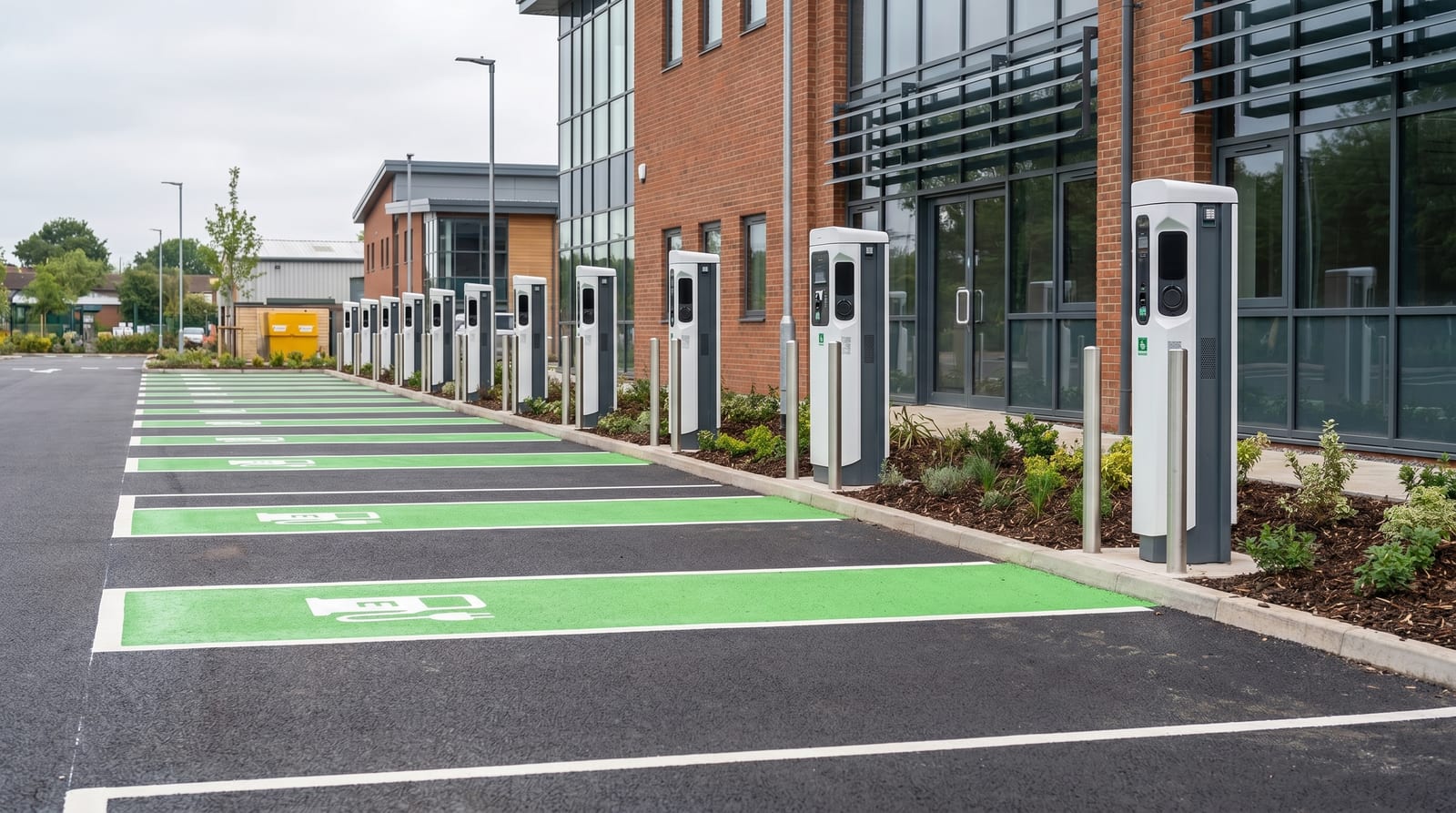
EV charger installation costs in the UK in 2026 range from around £900 for a standard home charger on a property with an accessible consumer unit, up to several hundred thousand pounds for commercial rapid charging hubs. The range reflects the very different engineering required for domestic, workplace, and commercial installations.
This guide sets out realistic costs for each segment in 2026.
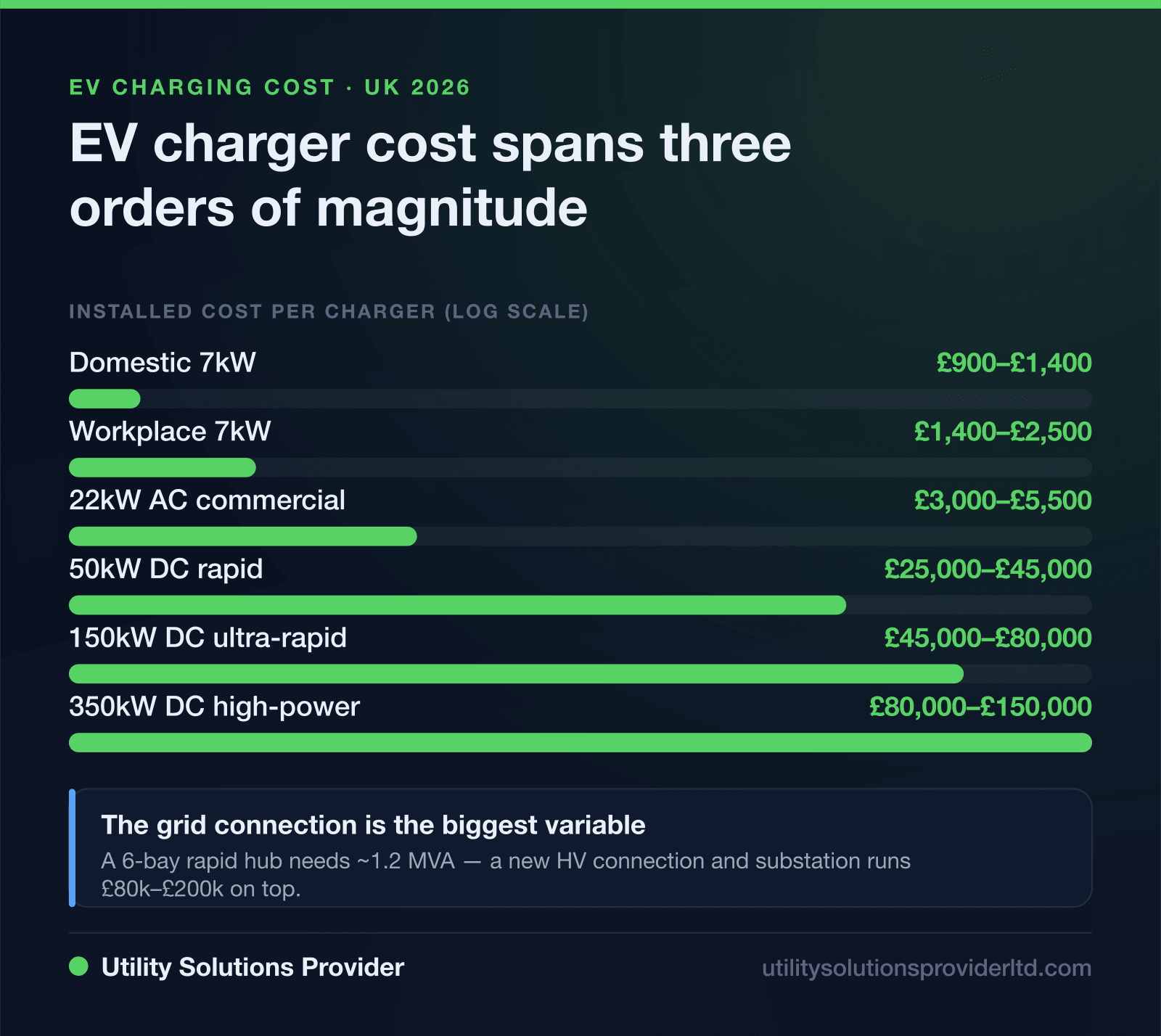
Installed cost per charger, from a domestic 7kW unit up to 350kW DC rapid.
Domestic EV Charger Installation
Home EV chargers are the biggest volume segment and the simplest installation type. A standard 7kW home charger on a property with modern electrical infrastructure typically costs:
Standard installation: £900 to £1,400.
Tethered charger with smart features: £1,100 to £1,600.
Installation with consumer unit upgrade: add £300 to £800.
Installation with long cable run from consumer unit to charging point: add £100 to £300 depending on distance and route.
The OZEV grant for homeowners ended in 2022 for most circumstances, but targeted grants still exist for flat-dwellers and renters through the EV Chargepoint Grant. Where eligible, the grant covers up to £350.
Three-Phase Home Chargers
Larger homes with higher existing loads can benefit from a three-phase 22kW home charger, but this requires a three-phase supply (many UK homes are single-phase only).
Three-phase 22kW charger installation on a property with existing three-phase supply: £1,800 to £3,000.
Upgrade from single-phase to three-phase supply to enable a 22kW charger: £5,000 to £12,000 including DNO charges and internal consumer unit changes.
For most homes, a 7kW single-phase charger is the right answer. Three-phase is justified where genuine high-power charging is needed or for properties with multiple EVs.
Workplace EV Charger Installation
Workplace charging ranges from a single charger for a director’s parking space up to full-car-park installations for employee and visitor use.
Single 7kW workplace charger with back-office software: £1,400 to £2,500 per charger.
Multiple 7kW chargers (5 to 10 chargers on a single site): £1,200 to £2,000 per charger plus shared infrastructure of £3,000 to £8,000.
22kW workplace chargers (AC fast): £2,500 to £4,500 per charger plus infrastructure.
The Workplace Charging Scheme (WCS) OZEV grant provides up to £350 per socket for up to 40 sockets, reducing the net cost meaningfully on medium-sized installations.
Commercial and Retail EV Chargers
Commercial chargers for customers, visitors, or fleet vehicles are typically higher-power (22kW AC or DC rapid) and include back-office billing systems.
22kW AC commercial charger with billing: £3,000 to £5,500 per charger.
50kW DC rapid charger: £25,000 to £45,000 per charger including installation.
150kW DC ultra-rapid charger: £45,000 to £80,000 per charger.
350kW DC high-power charger: £80,000 to £150,000 per charger.
These figures exclude the connection cost, which is a major additional item for DC rapid installations.
The Grid Connection Cost
The electrical connection is the single largest cost variable for commercial EV installations. Existing supplies rarely have enough capacity for DC rapid chargers.
A typical 6-bay retail charging hub with four 150kW and two 350kW chargers needs around 1.2 MVA of capacity. Delivering that typically requires:
New HV connection with customer substation: £80,000 to £200,000.
Main upgrade to the site if the existing supply is inadequate: variable, often £40,000 to £150,000.
Load management systems can reduce the peak demand and therefore the connection size, but only within limits.
EV Charger Installation for Housing Developments
New-build homes in England are now required to have an EV charge point under the Building Regulations. The typical provision is:
One 7kW charger per parking space on each new home: £700 to £1,200 per charger when installed at scale during the build.
Cabling provision to future charging points on non-dedicated spaces: £150 to £300 per space.
On apartment developments, central EV charging for communal parking adds complexity. A 10-space EV-ready car park with 7kW chargers typically costs £12,000 to £25,000 for charging infrastructure, plus any uplift in the electrical supply if needed.
Fleet EV Charging
Fleet installations sit between workplace and commercial in specification. Key differences:
Higher overnight utilisation, so charger durability matters.
Load management to avoid peak demand charges.
Fleet-specific back-office integrating with vehicle telematics.
Typical cost for a 20-vehicle fleet installation with 22kW chargers and load management: £80,000 to £180,000 including any electrical supply upgrades.
Hidden Costs to Watch
Several hidden costs appear on installation quotes and should be budgeted for.
Consumer unit or panel upgrades on older buildings.
Cable route obstructions requiring trenching or core drilling.
Civils for concrete pads or pedestal foundations.
Traffic management for works in public car parks or alongside highways.
Back-office software licences and payment integration fees.
Future upgrade provision: ducting and cable capacity for later expansion.
How to Get an Accurate Quote
Provide the installer with:
Site plan showing proposed charger positions.
Existing electrical supply details (capacity, phase, consumer unit condition).
Vehicle type and expected charging profile.
Programme.
Any site constraints (listed buildings, planning conditions, fire safety requirements).
Accurate inputs produce accurate quotes. Vague information means inflated contingency allowances.
The Bottom Line
EV charger installation costs in 2026 span three orders of magnitude, from a few hundred pounds for a home charger upgrade to hundreds of thousands for a commercial rapid charging hub. The right question is not just “how much does it cost” but “how do I specify the right installation for the use case”. Specification errors are the most expensive mistakes. Match the charger power to the actual use profile, provision the electrical supply correctly, and plan for future growth. The installation that serves today’s requirement and tomorrow’s is the one that delivers value over its lifetime.