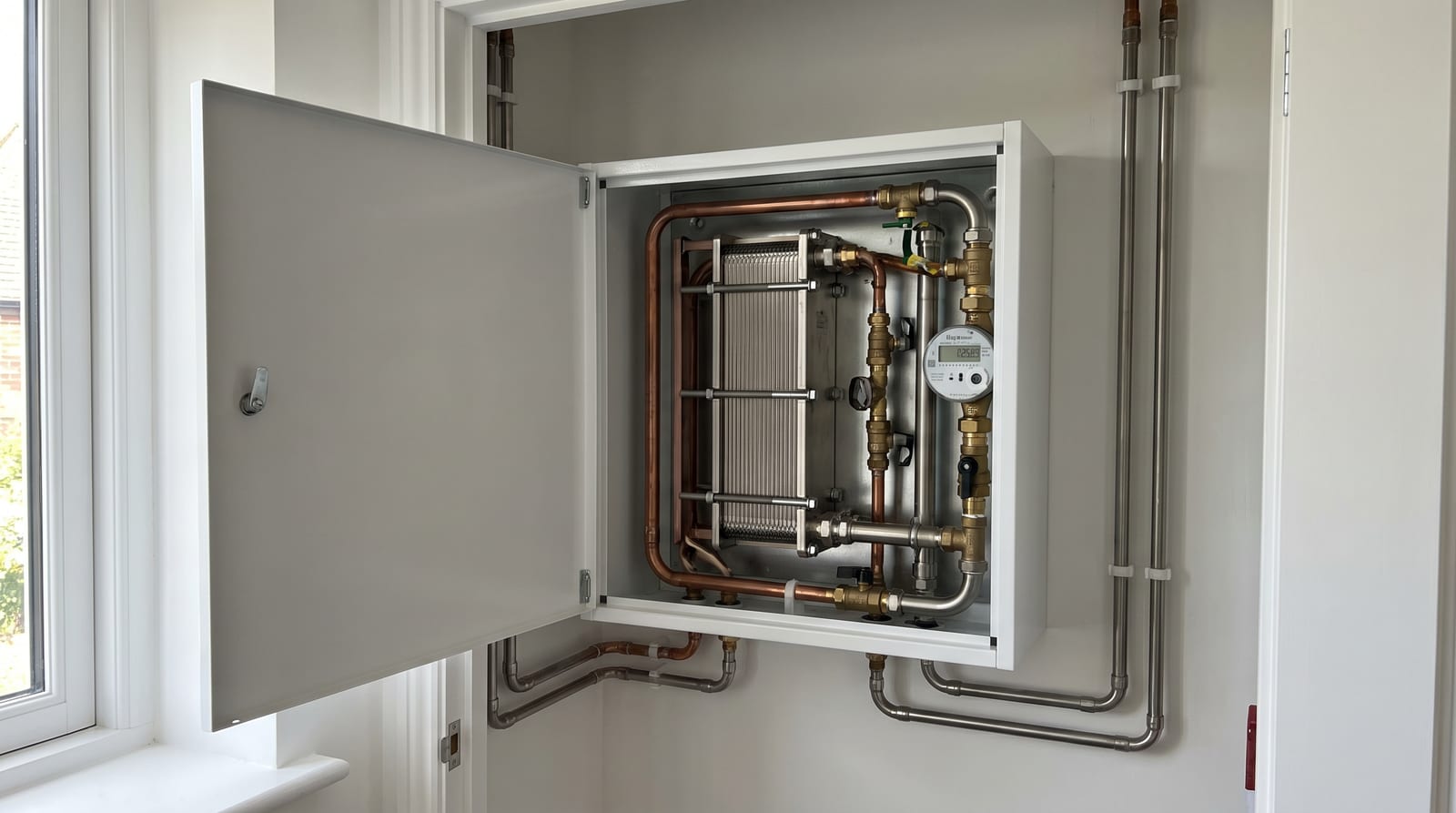
The heat interface unit (HIU) is the component that connects a building or flat to a district heating network. For anyone designing, building, or occupying a property on a heat network, the HIU is the most visible piece of equipment and the one that determines how well the heat network performs in daily use.
This guide covers what HIUs do, how they work, and what matters when specifying one.
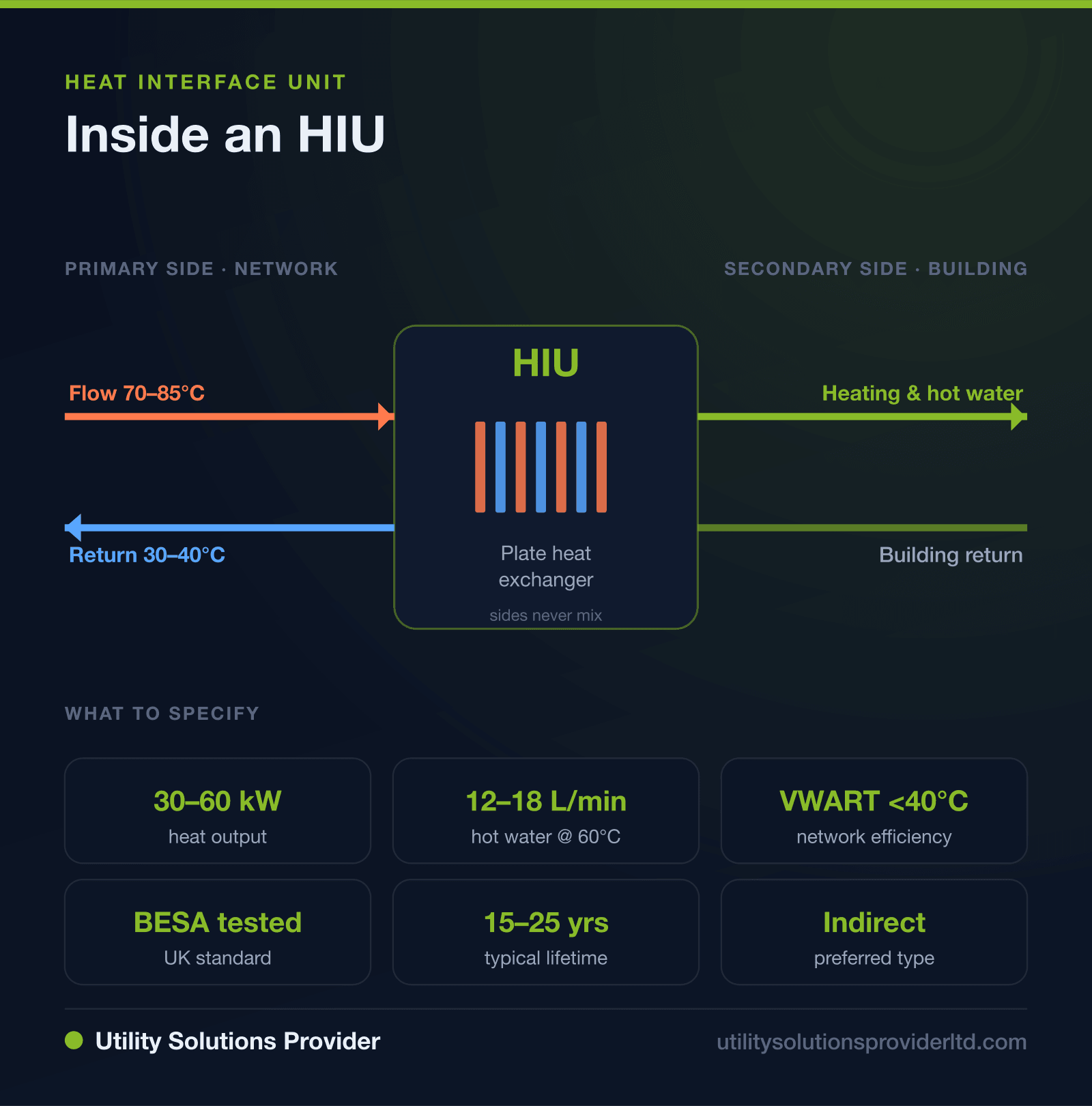
What sits inside an HIU and the key figures to specify.
What an HIU Does
An HIU performs four functions.
One. Heat exchange. It transfers heat from the district heating network’s hot water (the primary side) to the building’s own heating system (the secondary side) through a plate heat exchanger.
Two. Hot water preparation. It produces domestic hot water on demand, either instantaneously or through a small storage cylinder.
Three. Metering. It measures the amount of heat consumed by the building so the network operator can bill accurately.
Four. Control. It regulates the flow of heat into the building in response to thermostat demand.
The net effect is that a building connected to a district heating network gets heating and hot water from a compact wall-mounted unit, with no gas connection, no flue, no combustion, and no individual boiler to maintain.
Primary and Secondary Sides
The HIU separates the network water from the building water.
The primary side is connected to the district heating network. It receives hot water from the network (typically 70-85 degrees flow) and returns cooler water (target 30-40 degrees return).
The secondary side is connected to the building’s own heating and hot water circuits. It supplies heat to radiators or underfloor heating and produces domestic hot water.
The two sides do not mix. This is essential for network integrity and water quality.
Types of HIU
There are two main types.
Indirect HIUs have heat exchangers on both the heating and the hot water circuits. This is the standard for UK new build residential and provides full separation between network and building water.
Direct HIUs use network water directly in the heating circuit, with only the hot water side using a heat exchanger. These are simpler and cheaper but less common in the UK because they couple the building heating to network pressure and temperature.
For most UK new build residential applications, indirect HIUs are the right choice, and they sit at the heart of any well-executed network design.
Key Performance Parameters
When specifying an HIU, these parameters matter.
Heat output rating. Typical residential units deliver 30-60 kW, which is comfortably sized for a modern insulated flat.
Domestic hot water flow rate. Typical units deliver 12-18 litres per minute at 60 degrees. Higher-rated units can deliver 20+ litres per minute for larger properties.
VWART (Volume-Weighted Average Return Temperature). This is the key network performance metric. A low VWART means the HIU is cooling the network water effectively, which is essential for network efficiency. Target VWART is usually below 40 degrees.
Primary pressure drop. Low pressure drop across the HIU reduces network pumping energy.
Standby losses. Low standby losses reduce energy wastage when the HIU is not actively delivering heat.
The BESA HIU Test Regime
The Building Engineering Services Association (BESA) operates a test regime for HIUs that has become the de facto UK standard. Tested units have verified:
Heat output performance.
Hot water performance.
VWART under defined test conditions.
Standby losses.
Network performance in pulsed demand scenarios.
For any UK district heating project, specifying a BESA-tested HIU is essential. It provides confidence that the HIU will deliver the expected network performance.
Sizing the HIU
HIU size depends on three things.
The heat demand of the building, typically 2-5 kW for a modern well-insulated flat.
The domestic hot water demand, typically sized for the peak draw-off from showers and baths.
The network primary flow and return temperatures.
Oversizing wastes capital. Undersizing creates problems with comfort and hot water performance.
A good design approach is to size for 90th percentile demand plus a small safety margin, not peak theoretical demand.
Installation Considerations
HIUs are typically wall-mounted in a utility cupboard or kitchen. Installation requirements:
Adequate ventilation (though much less than a gas boiler).
Access for maintenance.
Space for the controls and pipe manifolds.
Acoustic consideration - well-designed HIUs are quiet but cheap ones can be audible.
Drainage for commissioning and potential overflow.
Electrical connection for controls and pumps.
Unlike gas boilers, HIUs do not require a flue, which opens up more flexible installation positions.
Commissioning
HIU commissioning is critical to network performance. Key commissioning steps:
Primary flow and return temperature verification.
Secondary temperature set points.
Flow rate verification on hot water.
Control valve calibration.
Heat meter verification.
Leak testing on both primary and secondary circuits.
Filter cleaning and flushing.
Poor commissioning is the single biggest cause of performance issues on HIUs. A properly commissioned unit will deliver the expected VWART and hot water performance for years. A poorly commissioned one will run hot on the return side, waste network energy, and deliver inconsistent hot water.
Maintenance
HIUs require periodic maintenance to maintain performance.
Annual service including filter cleaning and function testing.
Heat meter verification on a 2-5 year cycle depending on regulation.
Strainer cleaning if network water quality is problematic.
Valve replacement on a 10-15 year cycle.
Heat exchanger replacement only if performance degrades, which is rare on well-maintained units.
Most HIU manufacturers offer service contracts, or the network operator arranges maintenance.
Consumer-Facing Aspects
For the end user, the HIU should largely disappear. Key consumer-facing aspects:
Controls: typically a wall thermostat connected to the HIU. The user sees this, not the HIU itself.
Hot water performance: should match or exceed a combi boiler.
Heating response: should be as responsive as a combi boiler.
Noise: should be inaudible in normal use.
Displays: the HIU itself may have a small display showing heat consumption, or this may only be visible to the network operator.
A well-designed HIU installation gives the user an experience indistinguishable from a traditional gas boiler, except with no gas, no flue, no annual gas safety inspection, and no boiler breakdown risk. For a broader primer on how heat networks function, see what is district heating.
HIUs vs Gas Boilers
The comparison:
Space: HIUs are similar or slightly smaller than a combi boiler.
Cost: HIU purchase is similar to or slightly more than a combi boiler, but network connection cost is additional.
Running costs: heat price from the network versus gas cost. Usually competitive on a total-cost-of-ownership basis.
Maintenance: simpler than a gas boiler. No combustion, no flue gas.
Carbon: dramatically lower if the network is supplied from low-carbon sources, as set out in our guide to district heating vs individual gas boilers.
Reliability: simpler device with fewer failure modes. Typical HIU lifetime 15-25 years.
Common HIU Issues
Three issues come up repeatedly.
High return temperature (poor VWART). Usually caused by commissioning errors, oversized secondary flow, or bypass valves left open. Fixable with rework.
Hot water performance issues. Usually caused by undersizing or network flow temperature too low. Solved by specifying correctly at design stage.
Noise. Usually caused by pumps or control valves. Solved by specifying quieter components.
All three are avoidable with good design and commissioning.
The Bottom Line
Heat interface units are the component that makes district heating actually work for the end user. A well-specified, well-commissioned HIU delivers comfort and hot water performance equivalent to the best combi boilers, with lower carbon, lower maintenance, and a simpler device to live with. A poorly-specified or poorly-commissioned HIU creates dissatisfaction that can undermine the whole district heating proposition. For anyone designing, specifying, or operating a heat network, the HIU choice is not a commodity decision. It is a core part of delivering a good heat network to users.