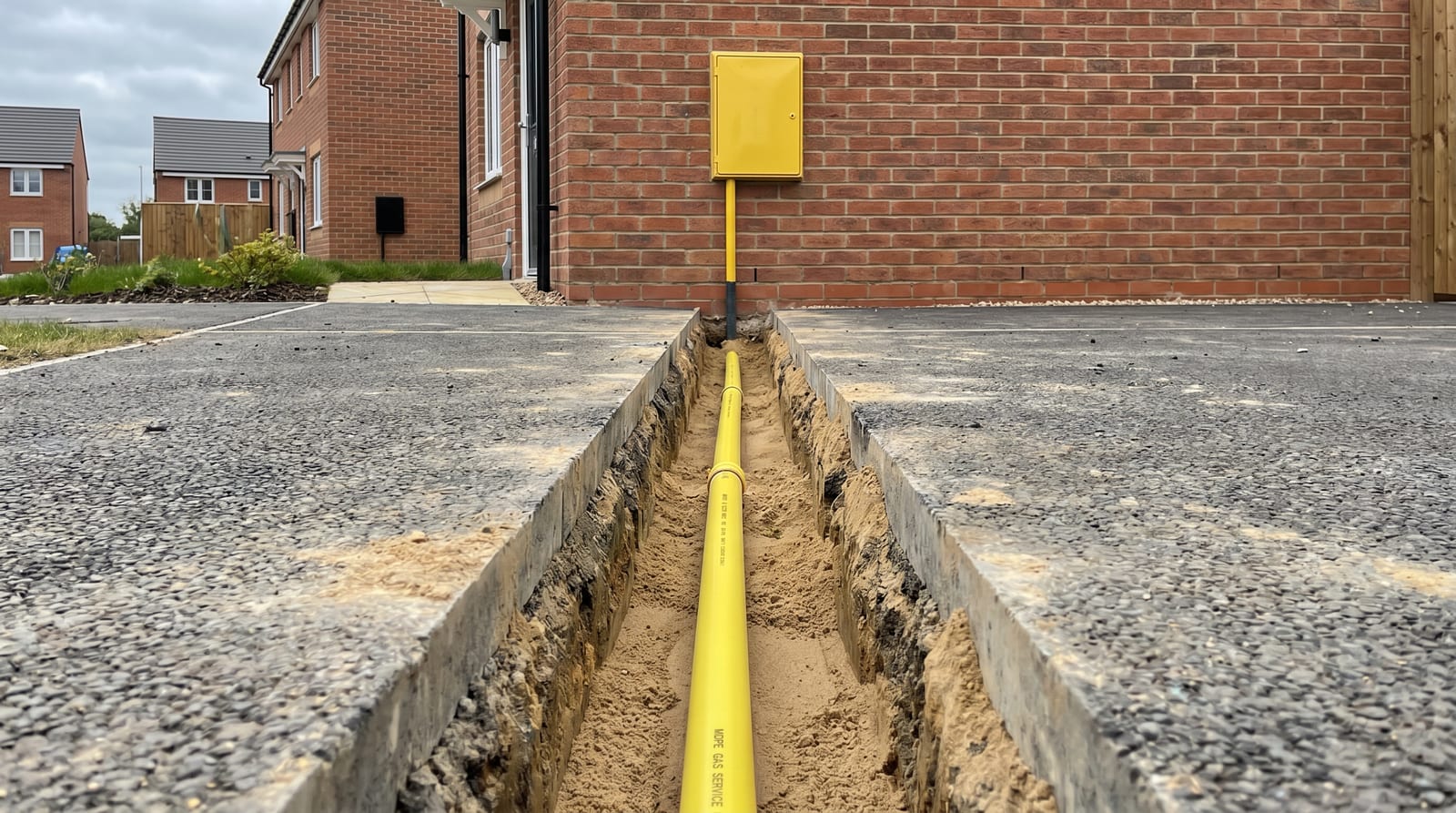
A new gas connection in the UK usually costs between £500 and £12,000, and the gap between those numbers is almost entirely down to site conditions. Domestic connections on an existing street tend to sit at the low end. Commercial and industrial connections, new housing developments, and anything that needs a main extension climb quickly.
This guide walks through the real cost drivers, the parties involved, and the questions to ask before you accept a quote.
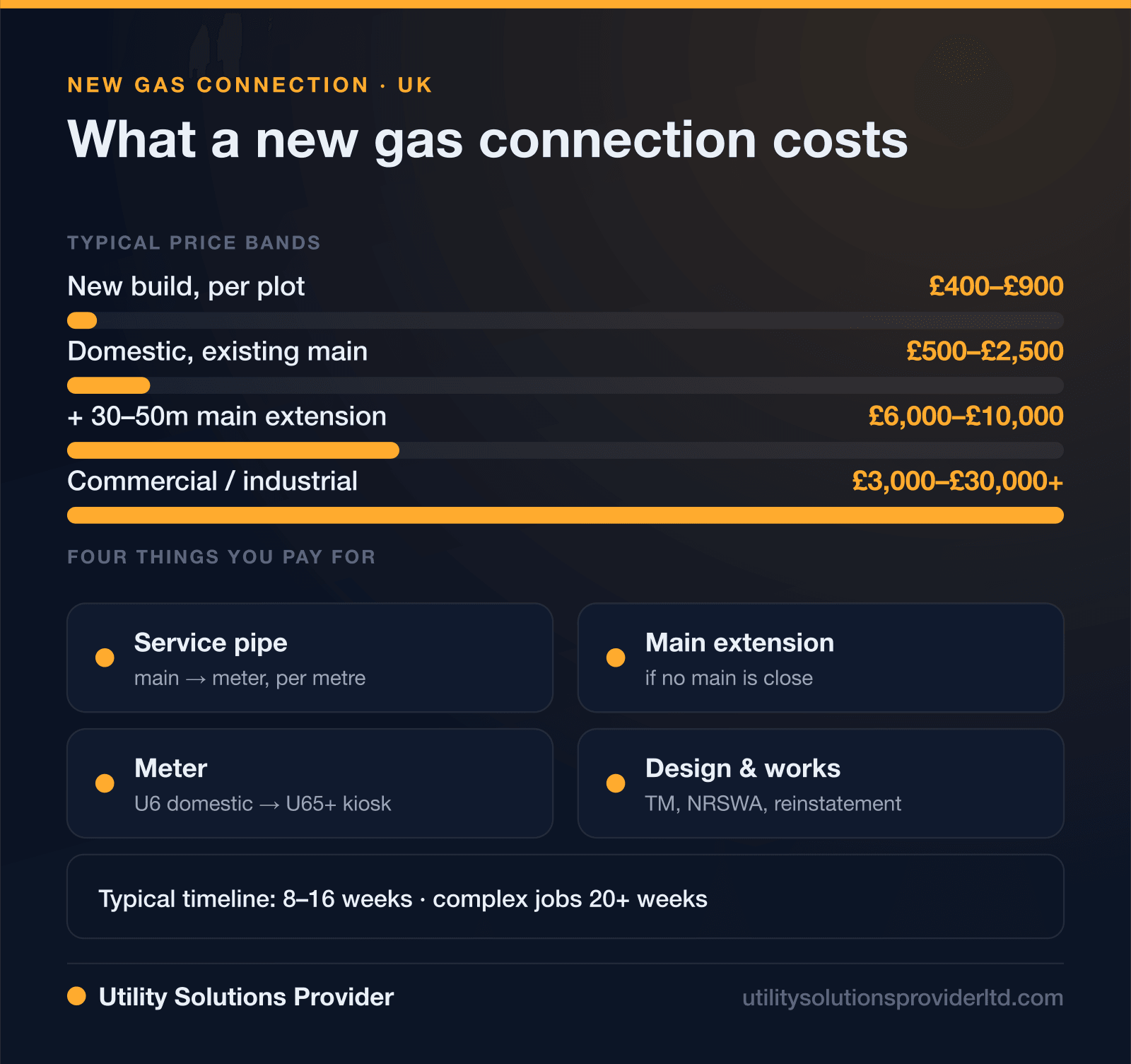
Typical price bands and the four things you pay for on a new gas connection.
What You Are Actually Paying For
A gas connection quote bundles four distinct costs.
The first is the service pipe from the existing gas main to your meter position. This is priced per metre and is the single biggest variable.
The second is the main extension if the nearest gas main is not close enough. Main laying is priced per metre of excavation and reinstatement, and can run to several thousand pounds on its own.
The third is the meter installation. A domestic U6 meter is inexpensive. Commercial U25, U40, U65 and larger industrial meters cost more and may need a meter housing kiosk.
The fourth is everything surrounding the physical work: design, traffic management, NRSWA notices, reinstatement of pavements or roads, and the GDN or IGT connection charge.
Domestic Gas Connection Costs
A straightforward domestic connection on a street with an existing low-pressure main typically runs £500 to £2,500. Expect the lower end if the main is directly outside the property and a short service pipe is all that is needed. Expect the higher end if the connection requires crossing the road, digging through block paving, or coordinating traffic management.
If the gas main is not close enough, a main extension is needed and costs rise sharply. Extensions of 30 to 50 metres push the total towards £6,000 to £10,000.
Commercial Gas Connection Costs
Commercial gas connections start at around £3,000 for small retail or office sites and run well above £30,000 for larger industrial loads, medium-pressure connections, or sites that need a dedicated governor.
The drivers are load size, pressure tier (LP, MP or IP), distance to a suitable main, and whether a kiosk is required for metering and pressure regulation. Restaurants and commercial kitchens often fall into the £5,000 to £12,000 band once U25 or U40 metering is specified.
New Build and Housing Development Connections
For housing developers, gas connections on new housing schemes are usually priced per plot once a main is laid through the estate. Per-plot pricing of £400 to £900 is common, but it depends heavily on plot density, ground conditions, and whether you route the design through the incumbent GDN or an Independent Gas Transporter (IGT).
Using an IGT often reduces upfront costs because the IGT retains the ownership of the assets and recovers revenue over time. The tradeoff is that it changes how the gas bill is structured for future residents.
What Makes a Quote More Expensive
Several site factors reliably push quotes up.
Long distances from an existing main are the biggest. Every extra metre of trenching adds cost.
Hard surfaces matter. Digging through a tarmac road costs more than digging through a soft verge because of reinstatement specification and traffic management requirements.
Traffic management can be a sizeable line item on its own. A road closure on a busy route with signalling and diversion signage is not cheap.
Crossings of other services, such as water, electricity, or telecoms, add survey and dig cost. A CCTV survey or trial holes may be needed before the main excavation starts.
Depth matters. If the main needs to sit deeper than standard (for example, under a drainage run), more excavation is needed.
How to Reduce Your Gas Connection Cost
Get at least two quotes. The incumbent GDN, such as Cadent or SGN, will offer a connection, but you can also obtain quotes from Utility Infrastructure Providers (UIPs) and ICPs who compete on contestable works.
Fix the meter position early. Changing meter location after a quote has been issued means a new design and a new quote.
Coordinate with other utility contractors. If electricity and water are being dug in at the same time, there is scope for shared trenches and shared traffic management, which reduces reinstatement cost.
Ask for a breakdown. A single headline figure tells you nothing. A line-by-line breakdown reveals where the cost sits and where there is room to negotiate.
Typical Timeline
Quotes take one to four weeks to issue. Design and approval adds two to six weeks. Physical installation is usually two to five days for a straightforward domestic connection, and one to four weeks for a commercial job. Meter fit follows once the service pipe is commissioned.
Plan for a total of eight to sixteen weeks from initial enquiry to a working meter on a standard commercial connection. Complex projects with main extensions and road crossings can stretch to twenty weeks or longer.
Getting a Realistic Quote
The quality of a quote depends on the quality of the information you provide. Supply the proposed meter position, a site plan showing the property boundary, the intended gas load in kW or m3/hr, the building use, and a realistic construction programme. Good information in means accurate quotes out, and fewer surprises later on. When you are ready, request a tailored quote with those details to hand.