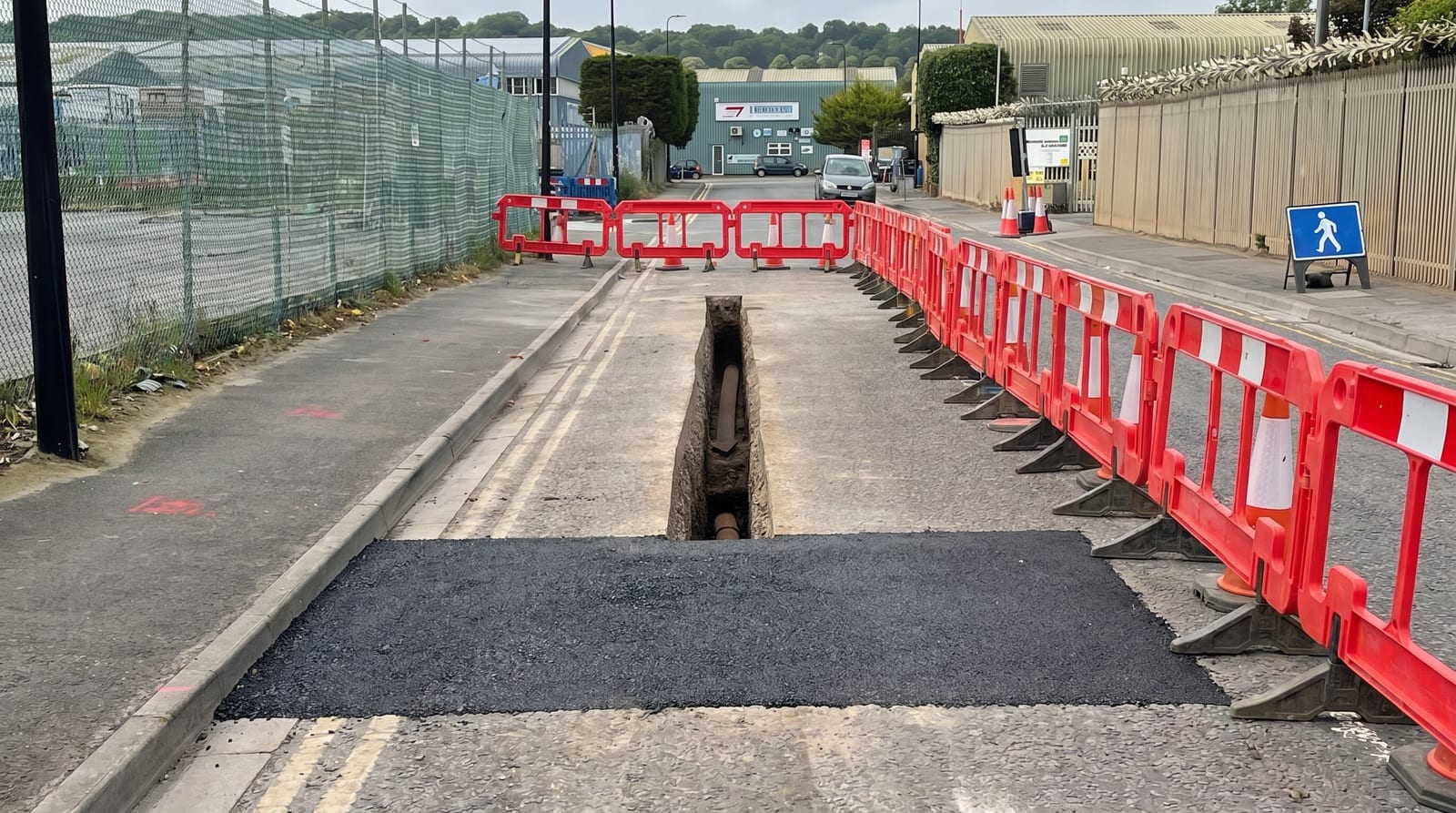
Any utility works that affect the highway in England and Wales are governed by the New Roads and Street Works Act 1991 (NRSWA). Getting NRSWA compliance right is essential for anyone carrying out utility connections, diversions, or disconnections that involve digging in a public road or pavement.
This guide covers what NRSWA compliance requires and how to avoid common pitfalls.
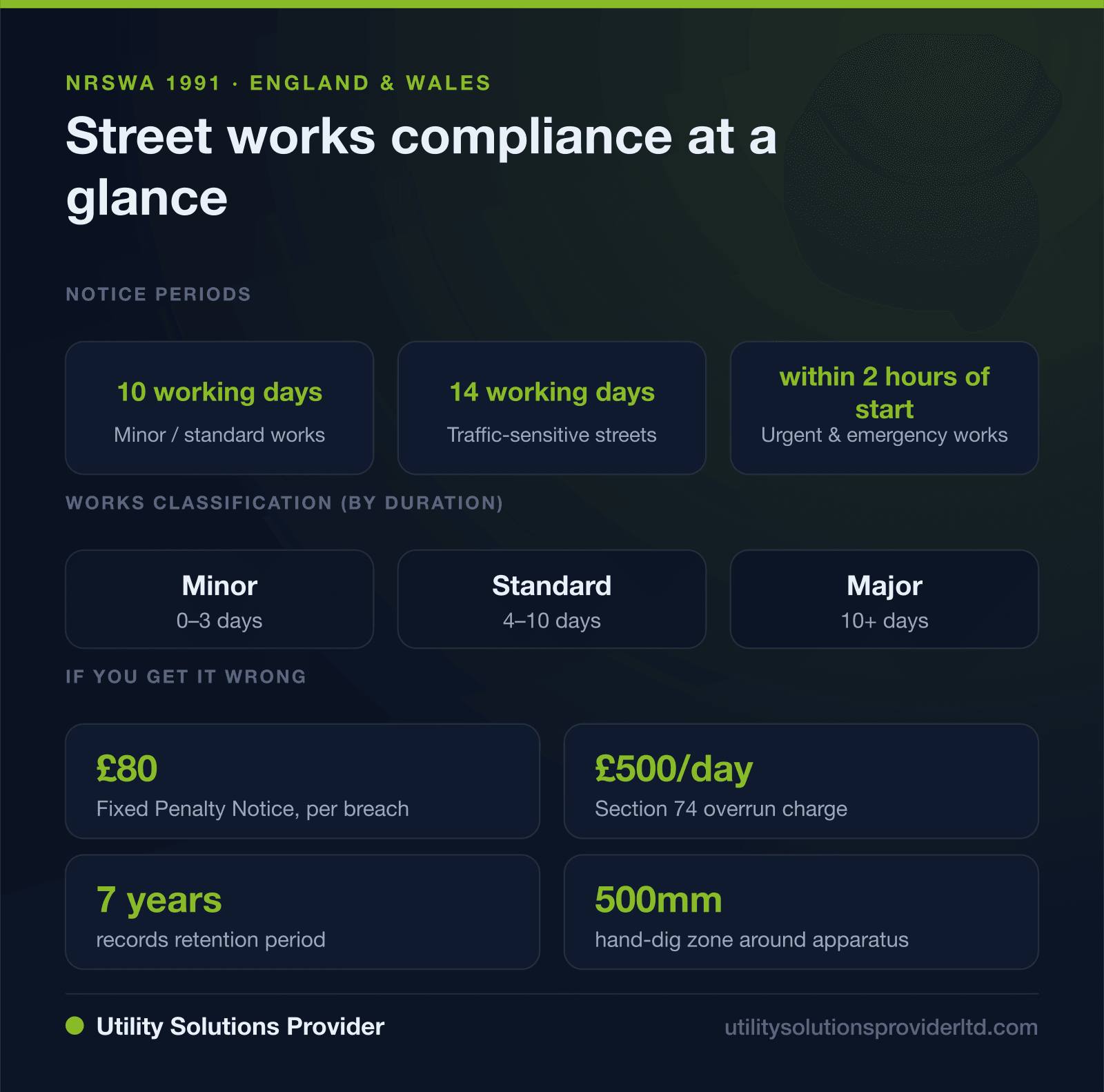
NRSWA notice periods, works classes and the penalties for getting it wrong.
What NRSWA Covers
NRSWA regulates:
All works by utility companies and their contractors in the highway.
Notification requirements before works start.
Operational rules during works.
Reinstatement standards after works (see our interim vs permanent reinstatement guide for detail).
Supervision requirements.
Inspections and quality checks.
Penalties for non-compliance.
The Act applies in England and Wales. Scotland has separate but similar legislation under the Transport (Scotland) Act. Northern Ireland has its own regime.
Key Qualifications: SROH and SWQR
NRSWA requires specific qualifications for supervisors and operatives.
Supervisors must hold the SROH (Supervisor’s Registration of Operatives in Highway) or equivalent.
Operatives must hold the SWQR (Street Works Qualifications Register) at the appropriate level for the work they perform.
Without these qualifications, operatives are not legally permitted to work on the highway.
Qualification types include:
Unit 1: Signing, lighting and guarding.
Unit 2: Excavation.
Unit 7: Locating and marking underground apparatus.
Unit 10: Reinstatement in modular surfaces.
Different work types require different unit combinations.
Permits and Notices
Every utility works on the highway requires notification to the street authority (usually the local highway authority).
Standard notice: 10 working days before minor works.
Urgent works: notification after the event, within 2 hours of work starting.
Emergency works: notification within 2 hours of work starting.
Under the Street Works Permit Scheme (in force in many UK authorities), permits rather than simple notifications are required. Permits include conditions such as working hours, methods, and duration.
Permit Schemes
Many street authorities operate Permit Schemes requiring:
A permit application for most works.
Specific working hours.
Restrictions on parking suspensions.
Traffic management conditions.
Fees for permit application and overrun charges.
London operates the Lane Rental scheme, with daily charges for occupying the most sensitive roads during peak times.
Works Classification
NRSWA classifies works by duration:
Minor works: 0-3 days.
Standard works: 4-10 days.
Major works: more than 10 days.
Minor works have less onerous notification but still require SWQR-qualified operatives and proper reinstatement.
Traffic Management
All utility works require appropriate traffic management:
Signing, lighting and guarding per Chapter 8 of the Traffic Signs Manual.
Traffic light control for road closures.
Pedestrian management for pavement works.
Access maintenance for residents and businesses.
Out-of-hours working if required by the permit.
Excavation Standards
Excavations must meet specific standards:
Appropriate depth for the utility being installed.
Safe support of excavation sides.
Control of water and ground stability.
Safe working practices for those working in the excavation.
Segregation of excavated materials.
The Specification for the Reinstatement of Openings in Highways (SROH) sets the standards.
Reinstatement Standards
The reinstatement standards are the heart of NRSWA compliance.
Materials: must match the original construction.
Compaction: layers must be properly compacted.
Levels: reinstated surface must match surrounding.
Joints: must be sealed properly.
Surface finish: must match surrounding road texture.
Warranty: typically 2-3 years for carriageway reinstatement.
Inspections
The street authority carries out inspections:
Category A: works in progress, typically during the work.
Category B: defective works, typically within 6 months of completion.
Category C: random sample inspection of the reinstated surface.
Failures lead to remedial work at the utility’s cost and potentially financial penalties.
Financial Penalties
Non-compliance can be expensive.
Fixed Penalty Notices (FPNs) for specific breaches, £80 per notice.
Section 74 charges for overrun works, up to £500 per day over the permitted duration.
Permit scheme overrun charges.
Defect rectification costs.
Reputational damage and loss of contractor accreditation.
A poorly-managed project can easily accumulate penalties in the thousands.
Record Keeping
Compliance requires thorough records:
Permit numbers and dates.
Site diaries.
Photos of before, during and after works.
Reinstatement records.
Qualification records for personnel on site.
Inspection reports.
Retention period is typically 7 years.
Working Near Apparatus
Works often affect other utilities in the highway.
Cable plans from all other utilities must be obtained before starting.
CAT and Genny surveying locates apparatus.
Hand digging within 500mm of known apparatus.
Damage to third-party apparatus causes cost, delay, and possible legal liability.
Utility damage is one of the most common NRSWA non-compliance issues, and it is one reason a well-defined project process pays dividends.
Traffic Sensitive Streets
Certain streets are designated traffic sensitive. Works on these roads face additional restrictions:
Longer notification periods (14 working days).
Restricted working hours (often avoiding peak times).
Tighter permit conditions.
Higher lane rental charges in some authorities.
Working in traffic sensitive streets requires careful planning to avoid overrun charges.
Duration Agreements
For complex works, duration agreements with the street authority can provide more flexible terms than standard permits.
Pre-agreed working windows.
Coordinated phasing with other works.
Aggregated permit arrangements.
Reduced inspection regimes for trusted contractors.
These require a working relationship with the street authority.
Winter Working
Winter presents additional challenges:
Cold weather can affect bitumen performance.
Night working to avoid peak traffic.
Weather-dependent working windows.
Longer reinstatement periods.
Some street authorities restrict winter working on traffic sensitive streets.
Common Pitfalls
Several issues come up repeatedly.
Starting works without proper notification. Results in FPNs and potentially enforcement action.
Overrunning permits. Results in daily charges.
Inadequate reinstatement. Results in defect rectification and Category B failures.
Damaging third-party apparatus. Costly and time-consuming to resolve.
Employing unqualified operatives. Results in enforcement and possible work stoppage.
Poor traffic management. Results in public complaints and possible accidents.
Using an ICP or Main Contractor
Most utility developers do not carry out street works themselves. They engage an Independent Connection Provider (ICP) or specialist utility contractor.
For the client, this means:
The contractor takes the direct NRSWA compliance burden.
The contractor’s accreditations and qualifications matter.
The contractor’s insurance and approach to risk matter.
Poor contractor performance reflects on the client project.
Selecting a reputable, accredited contractor is the single biggest compliance decision. The same discipline helps on live cable diversions and other high-risk works.
Coming Changes
NRSWA and associated regulation continues to evolve.
Digital permit systems are becoming universal.
Real-time reporting requirements are increasing.
Environmental considerations (noise, dust, air quality) are becoming more stringent.
Community impact is being weighted more heavily in permit decisions.
Staying current with regulation is essential.
The Bottom Line
NRSWA compliance is fundamental to successful utility works. Non-compliance is expensive, reputationally damaging, and can delay or stop projects. The compliance burden is best managed by working with accredited contractors, planning works well in advance, maintaining good relationships with street authorities, and investing in the operational standards that deliver quality every time. For utility developers, NRSWA compliance is not just a legal requirement but a measure of the contractor’s quality and professionalism. If you are scoping works, get a quote with the street authority context built in.