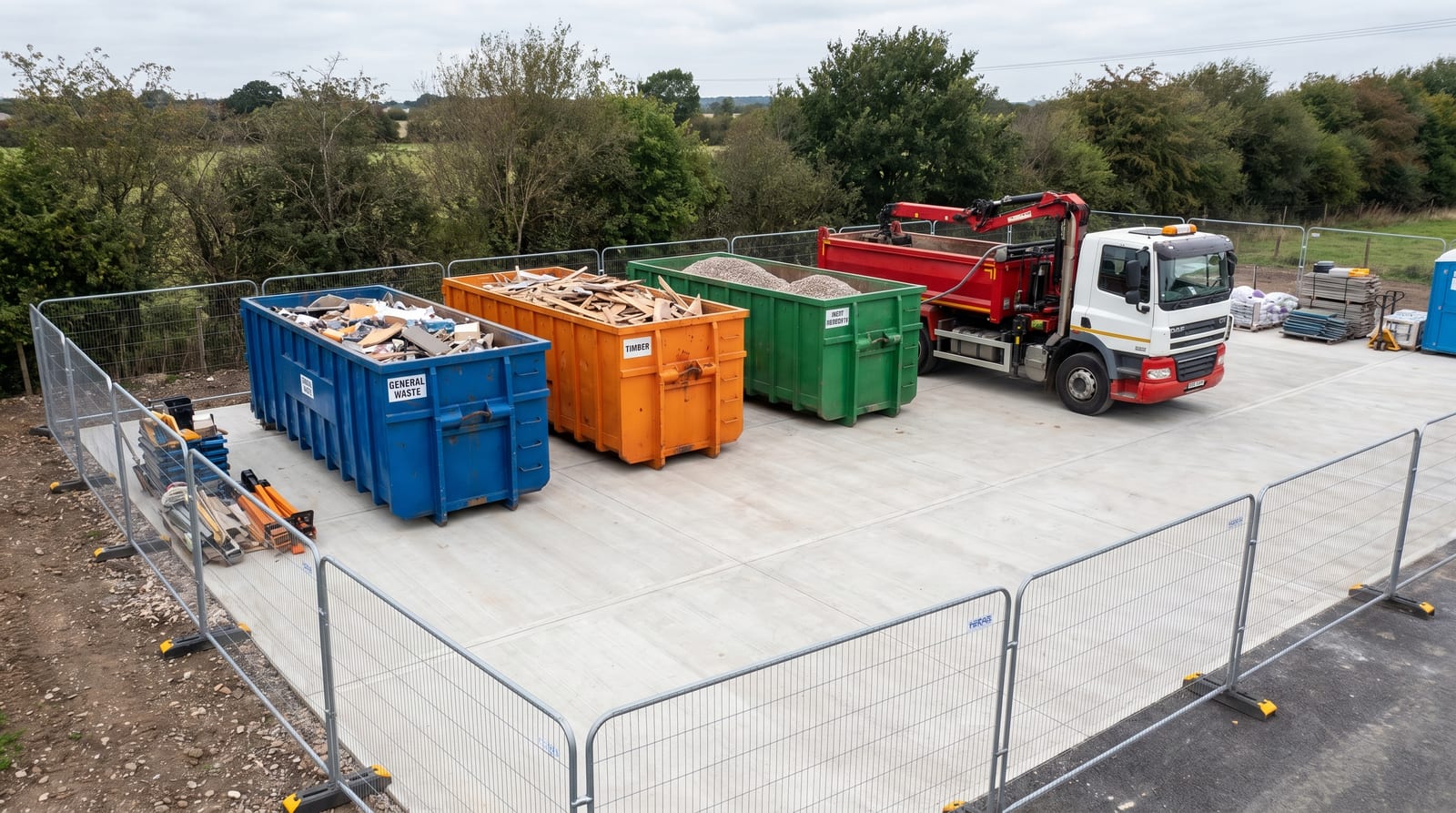
A Waste Transfer Note (WTN) is the paperwork that accompanies every load of non-hazardous waste moved between parties in England, Wales, and Northern Ireland. Without one, you are breaking the law. With a sloppy one, you are carrying the liability.
This guide covers what a WTN is, when you need one, the fields it must contain, how long to keep it, how to verify your waste carrier, and includes a free template you can copy into any project handover pack.
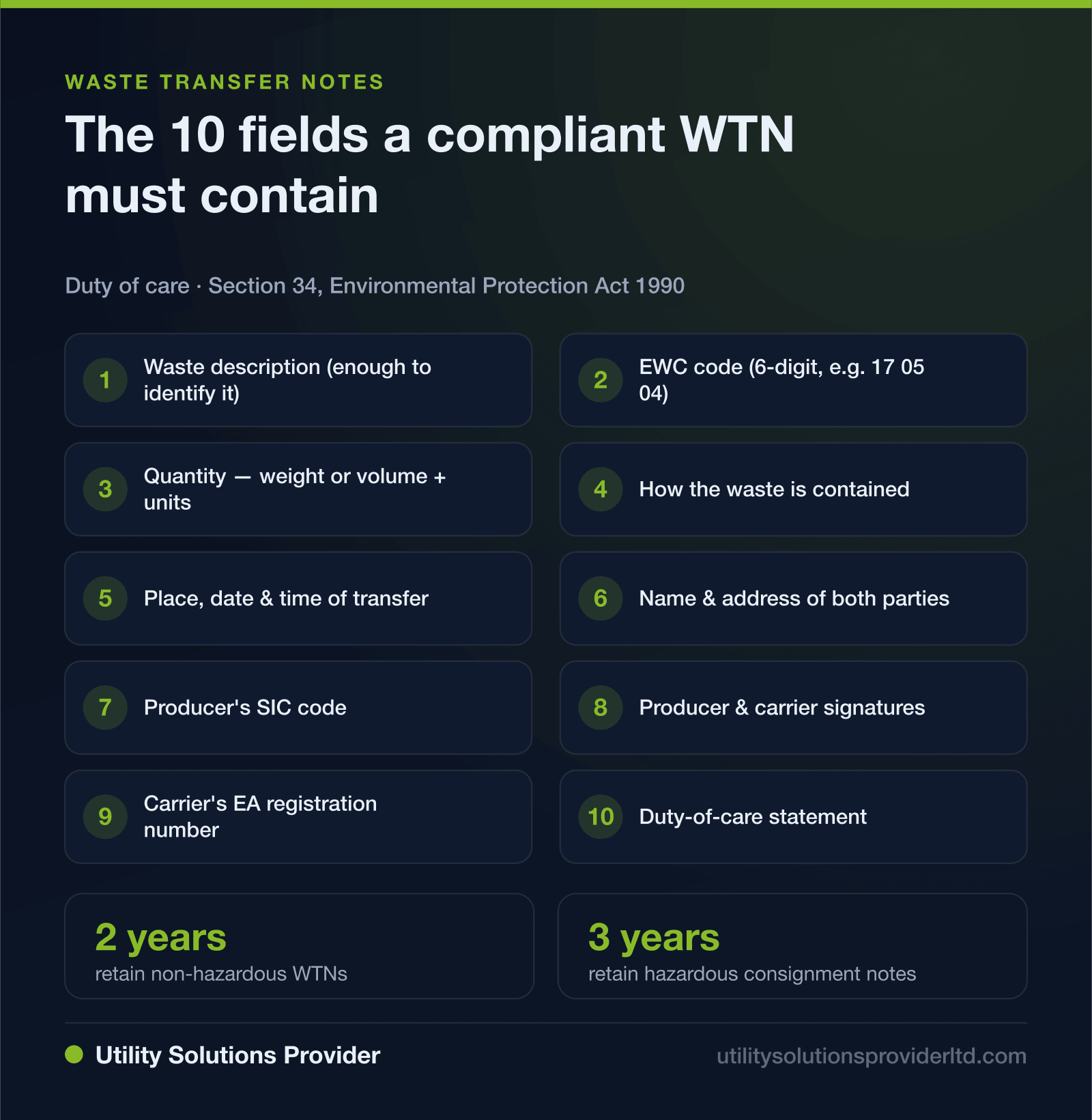
The ten fields a compliant Waste Transfer Note must contain, plus retention periods.
What is a Waste Transfer Note?
A Waste Transfer Note is a written document signed by both the producer (the person giving up waste) and the carrier (the person collecting it), recording a transfer of non-hazardous waste from one holder to another. It evidences that both parties have met their legal duty of care under Section 34 of the Environmental Protection Act 1990.
For hazardous waste, the equivalent document is a Hazardous Waste Consignment Note, which has stricter requirements and is submitted to the Environment Agency.
A WTN is required every time non-hazardous waste changes hands. Every load, every delivery.
When you need a Waste Transfer Note
If any of the following apply on your site, you need WTNs:
- Excavation spoil removed by a third-party muck-away contractor
- Construction and demolition waste collected in skips or grab lorries
- Brick, concrete, tarmac, or aggregate taken off site for disposal or recycling
- Green waste, topsoil, or turf removed for off-site disposal
- General construction waste (timber, plasterboard, packaging) removed by a registered carrier
The producer of the waste is whoever generated it, typically the principal contractor on the site. The carrier is the person physically moving it. Both parties have duty-of-care obligations, and both must hold a signed copy of the WTN.
If your utility connection contractor handles reinstatement and muck away themselves, you should receive the WTN pack on project completion as a matter of course. Ask for it at quote stage so it is written into the deliverables.
The required fields on a WTN
A compliant Waste Transfer Note must contain:
- A description of the waste in enough detail to allow anyone to identify it. “Excavation spoil — mixed inert (soil, stone, clay)” is acceptable. “Waste” is not.
- The European Waste Catalogue (EWC) code. Each waste stream has a 6-digit code. Inert excavation spoil is typically
17 05 04(soils and stones other than those mentioned in17 05 03). Your carrier should supply the correct code; if they don’t know, that is a red flag. - The quantity — by weight or volume, with units specified.
- How the waste is contained — loose load, bulk bag, skip, drums, etc.
- The place, date, and time of transfer.
- The name and address of both parties — producer and carrier.
- SIC code (Standard Industrial Classification) for the producer’s business activity.
- The producer’s and carrier’s signatures.
- The carrier’s registration number with the Environment Agency (or Natural Resources Wales / SEPA for Wales / Scotland).
- A statement that both parties have met their duty of care.
A missing field is a non-compliant note. You can be fined for accepting one.
How long to keep a Waste Transfer Note
- Non-hazardous waste (standard WTN): 2 years minimum retention by both parties.
- Hazardous waste (Consignment Note): 3 years minimum retention.
Keep originals in a dry, accessible place. Electronic copies are acceptable provided they are clearly indexed and retrievable. The Environment Agency or local authority can request to see them at any time during the retention period.
For construction projects, include the WTN pack in the site file handed over to facilities management or the client on completion. Waste records are one of the first things asked for in any enforcement investigation.
Duty of care (Section 34 Environmental Protection Act 1990)
Duty of care means that anyone who produces, keeps, transports, imports, or disposes of waste has a legal obligation to:
- Store the waste safely, securely, and without risk to the environment.
- Transfer it only to an authorised person (a registered waste carrier, or a permitted facility).
- Provide a written description of the waste (the WTN).
- Keep records for the required retention period.
Who carries the liability? Both parties. If your waste carrier fly-tips, both you and they face prosecution. The WTN is your evidence that you met your duty. Without it, you carry the carrier’s liability.
How to check your waste carrier’s licence
Before accepting a WTN from a carrier, verify their registration. It takes 30 seconds.
- Go to the Environment Agency’s Public Register.
- Search by carrier name or registration number.
- Confirm they hold either a lower-tier (transporting own waste only) or upper-tier registration (transporting third-party waste — the level construction contractors need).
- Check the registration is currently valid, not expired, and not suspended.
If the carrier can’t supply a registration number, or the registration doesn’t appear on the public register, do not let them take waste off site. You carry the liability.
Free Waste Transfer Note template
Copy the table below into any project handover pack. This covers the minimum Section 34 requirements for non-hazardous waste.
| Field | Entry |
|---|---|
| Transfer date | |
| Transfer location | |
| Transfer time | |
| Waste description | |
| European Waste Catalogue code | |
| Quantity (tonnes or m³) | |
| Containment | |
| Producer name | |
| Producer address | |
| Producer SIC code | |
| Producer signature | |
| Carrier name | |
| Carrier address | |
| Carrier EA registration number | |
| Carrier signature | |
| Receiving facility name | |
| Receiving facility permit number | |
| Duty of care statement | Both parties confirm they have taken all reasonable measures to comply with Section 34 of the Environmental Protection Act 1990. |
Retain for 2 years (non-hazardous) or 3 years (hazardous) from the date of transfer.
Consequences of a missing or incorrect WTN
Failing to keep WTNs, or accepting non-compliant ones, carries real penalties:
- Fixed penalty notice from the local authority: £300 for individuals, larger fines for businesses.
- Unlimited fine on conviction under Section 34 for serious or repeated breaches.
- Corporate liability if the waste is subsequently fly-tipped by a non-compliant carrier. The producer can be prosecuted alongside the carrier because they failed to take “reasonable measures” to ensure the waste was being handled lawfully.
- Reputational damage. Enforcement action is published. For contractors bidding on public-sector framework agreements, a waste offence can disqualify you for years.
The cost of compliance is negligible. The cost of non-compliance is serious. Always insist on a WTN, always verify the carrier, always retain the paperwork.
How USP handles waste on reinstatement works
When USP removes spoil from a utility excavation, we supply a WTN with every load. We are a registered upper-tier waste carrier, and our registration number is supplied on every quote and every note. Waste is routed to Environment Agency permitted facilities, with inert spoil sent for aggregate recycling where feasible. On project completion, the client receives a full WTN pack for retention.
Read more about our muck away and spoil removal service, or see how it fits into our full utility reinstatement offer.
Related reading
- NRSWA compliance for utility works — the broader compliance picture for works on the highway.
- Interim vs Permanent Reinstatement — what happens to the surface after the spoil is removed.
- Utility Reinstatement Services — USP’s end-to-end reinstatement and muck-away offering.
- Disconnections and alterations — where spoil removal is often a significant scope item.
For a connection and reinstatement quote that includes full WTN paperwork from day one, contact USP or call 024 7542 6505.