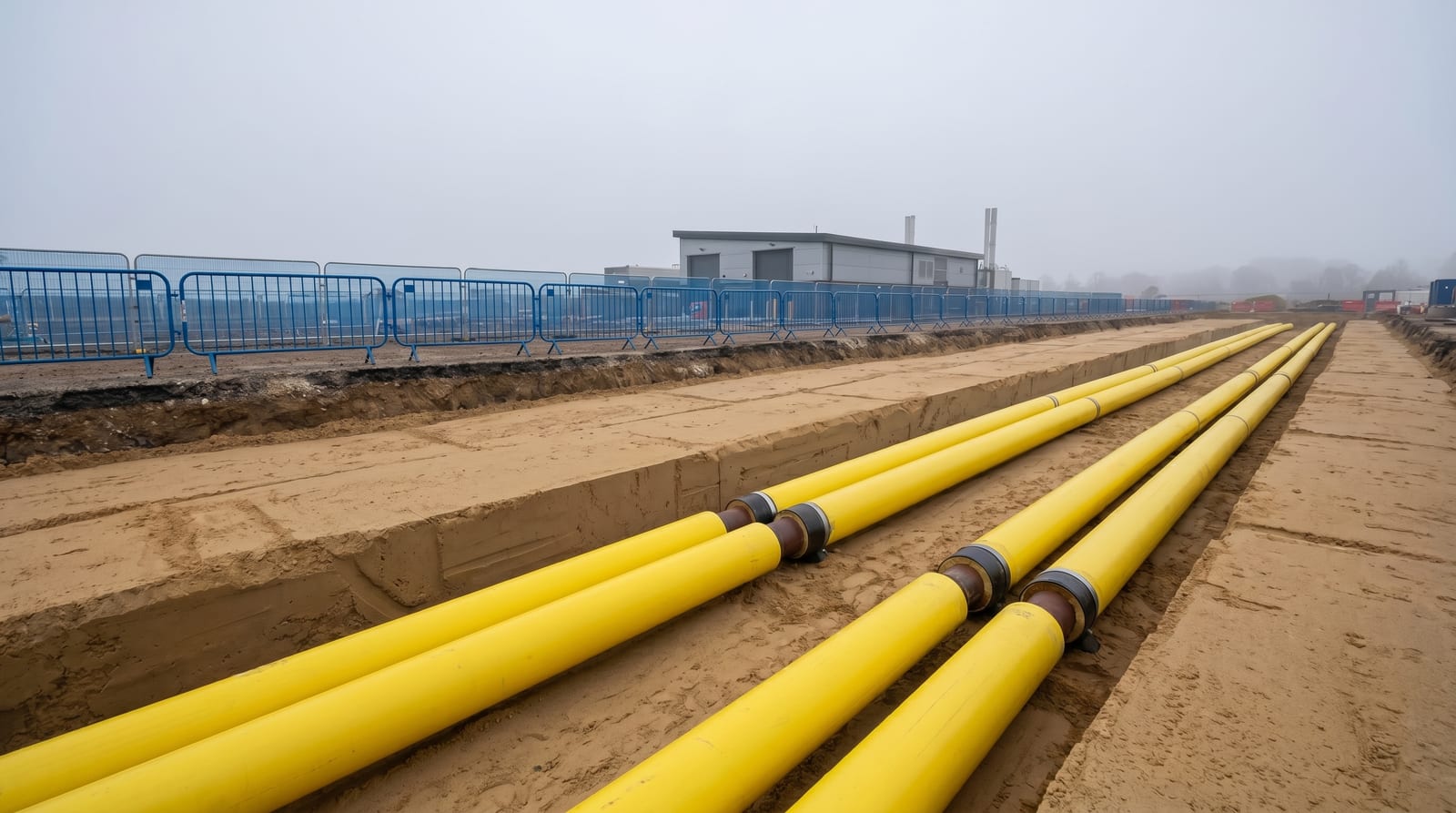
District heating is a system that distributes heat from a central source to multiple buildings through a network of insulated pipes. Instead of every building having its own gas boiler, the heat is generated once and piped to where it is needed. In the UK, district heating is growing rapidly, driven by net zero policy, the need to decarbonise heat, and the efficiency gains available at scale.
This guide is a plain English introduction for developers, architects, and building owners.
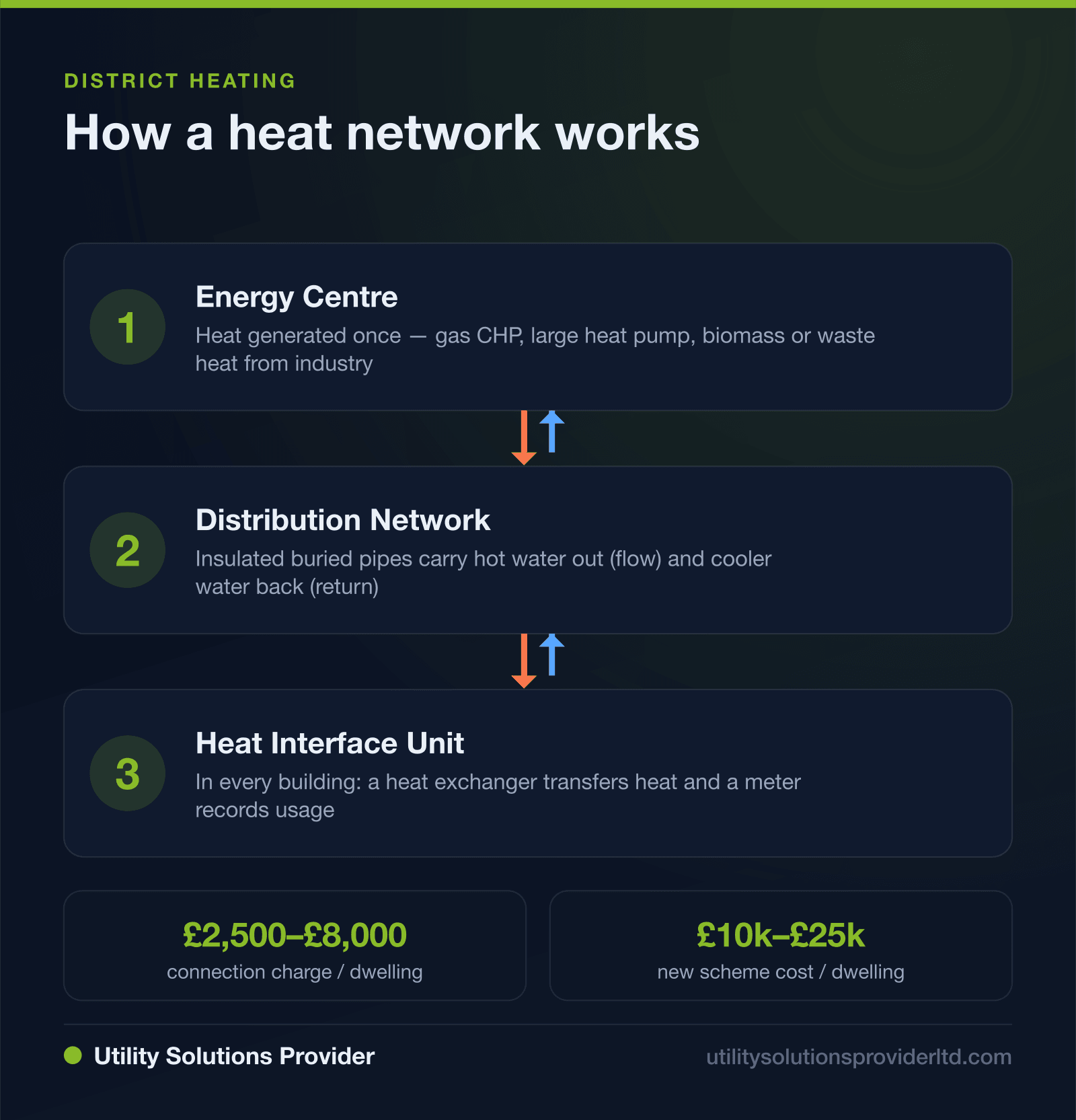
How heat moves from a central energy centre to each building on a heat network.
How District Heating Works
A district heating network has three main parts.
One. A central energy centre that generates heat. This can be a gas-fired CHP plant (combined heat and power), a large heat pump, a biomass boiler, or a connection to waste heat from industry or data centres.
Two. A distribution network of insulated pipes that carry hot water (or steam, in some older systems) from the energy centre to the buildings.
Three. A heat interface unit (HIU) at each building that transfers heat from the network to the building’s internal heating and hot water.
Consumers on the network pay for the heat they use, metered at the HIU, rather than paying for gas or electricity to fuel their own boiler.
Where District Heating Makes Sense
District heating is most efficient in areas of high heat density: many buildings close together, with high combined demand. Typical contexts include:
Urban residential developments: high-rise flats, mixed-use regeneration sites.
Mixed-use schemes combining residential, office, and retail.
University and hospital campuses.
Industrial parks.
City centre regeneration.
District heating is usually not economic in low-density suburban contexts where the pipe network cost per connected building is too high.
The UK Policy Context
Multiple UK government policies are driving district heating growth.
The Future Homes Standard requires low-carbon heating in new homes from 2025, and district heating is one of the qualifying solutions.
The Heat Network Zoning framework, taking effect progressively through the late 2020s, designates areas where district heating will be the default heating solution for new and existing buildings.
The Heat Networks (Metering and Billing) Regulations require heat network operators to meter heat use and bill fairly.
Planning policy in many local authorities encourages or requires district heating on larger developments.
For developers, the regulatory direction is clear: district heating is moving from optional to expected in many UK urban contexts.
New Build Connections
For new buildings, district heating connection involves:
Confirmation that a network is available or planned in the area.
Agreement with the network operator on terms of connection.
Installation of the heat interface unit (HIU) in each flat or building.
Connection of the HIU to the network mains.
Commissioning and handover.
The developer pays a connection charge. The end user then pays for heat consumption on an ongoing basis, similar to a gas or electricity bill.
New District Heating Schemes
For developments without an existing network, building a new scheme involves:
Feasibility study and heat demand analysis.
Energy centre design and plant procurement.
Distribution network design and installation.
HIU specification for each building.
Commissioning and testing.
Ongoing operation, either by the developer, a specialist operator, or a joint venture.
New schemes typically have a development timeline of 2-4 years from initial concept to first heat delivery.
The Heat Interface Unit
The HIU is the component that the end user interacts with. It contains:
A heat exchanger that transfers heat from the network to the building’s internal system.
A heat meter that records consumption.
Controls that regulate the temperature of heat delivered to the building.
Sometimes, a hot water storage cylinder for rapid draw-off.
HIUs are roughly the size of a traditional combi boiler and are typically wall-mounted in a utility room or cupboard.
Costs
District heating costs are often comparable to or slightly below alternative heating solutions when viewed over the full life cycle.
Connection charges for new buildings typically run £2,500 to £8,000 per dwelling on major network-led developments.
For new scheme builds, the network infrastructure cost is substantial but spread across many users. Typical scheme cost is £10,000 to £25,000 per dwelling served, including the energy centre.
Ongoing heat prices vary by network and energy source. Well-operated modern networks deliver heat at prices competitive with gas boilers on a total-cost-of-ownership basis.
Pros and Cons
Advantages of district heating:
Decarbonisation: enables a shift to low-carbon heat sources without replacing every boiler.
Efficiency: centralised plant operates at higher efficiency than individual boilers.
Space savings: no boiler in every flat, no individual flue requirements.
Reliability: professionally operated and maintained plant.
Disadvantages:
Long-term lock-in: once connected, customers cannot easily switch to an alternative heat source.
Price regulation is still developing. Early networks had reputational issues with pricing transparency.
Requires scale to be economic.
Disruption during installation.
Regulatory Protection for Consumers
The UK is introducing heat network regulation through Ofgem, which will provide consumer protection similar to gas and electricity. Key features:
Price transparency.
Customer service standards.
Regulated dispute resolution.
Technical quality requirements.
Metering and billing standards.
Regulation is coming into force progressively through 2025-2028.
Planning for a Development
For a developer considering district heating:
Check whether your site is within a Heat Network Zone or likely to be.
Engage with the local authority and any existing network operator at feasibility stage.
Get a heat demand assessment for the development.
Compare district heating against alternatives (individual heat pumps, communal heat pumps, direct electric) on cost and compliance.
Plan the plant and distribution space early. HIUs take up less space than boilers but the network needs service space.
The Bottom Line
District heating is no longer a niche solution. In many UK urban contexts, it is becoming the default low-carbon heating option, driven by policy, economics, and the practical challenges of decarbonising heat at scale. For developers, understanding how district heating works, where it makes sense, and how to integrate it into design is an increasingly essential capability. The developments that will age well are the ones that considered district heating seriously at the feasibility stage, even if they ultimately chose a different solution.