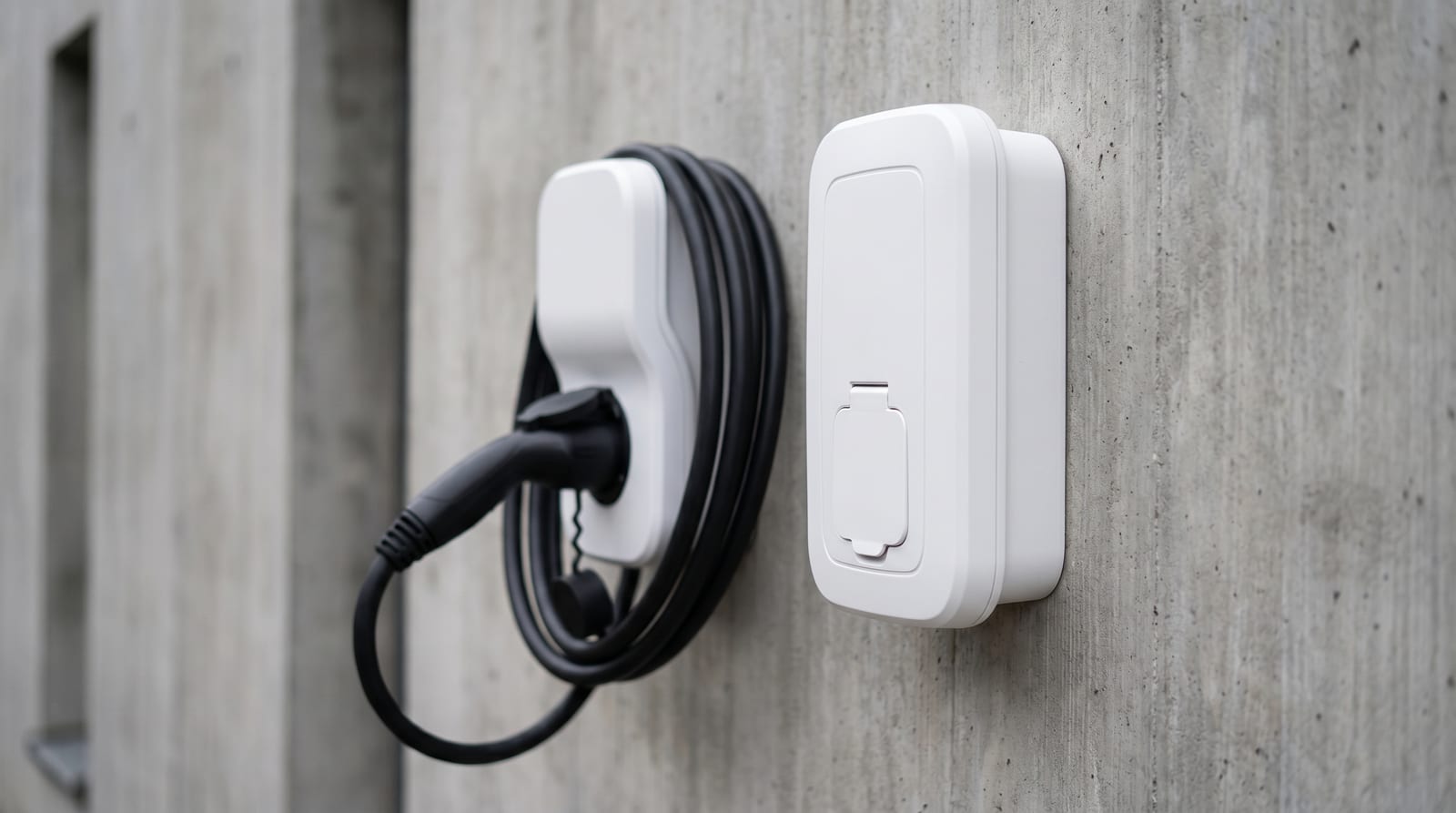
7kW and 22kW AC chargers are the two most common EV charger types in the UK. They look similar but deliver very different experiences for users, and they have different installation requirements. Choosing between them comes down to three questions: how long will users stay, does the vehicle support 22kW, and is there a three-phase electrical supply available?
This guide walks through the differences and when to use each.
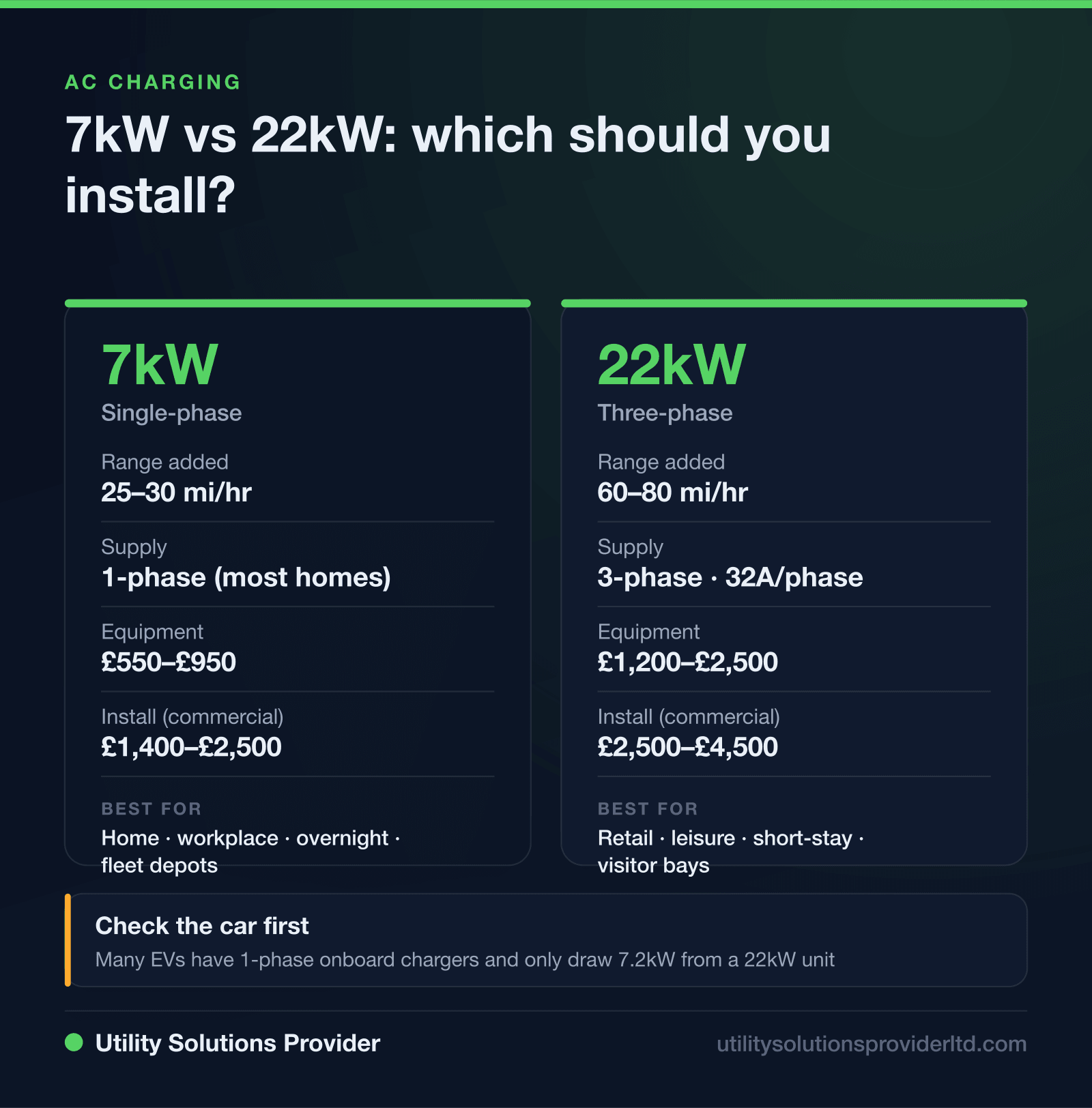
7kW versus 22kW AC chargers, head to head.
The Numbers
A 7kW charger adds around 25 to 30 miles of range per hour of charging. In a full eight-hour workplace stay, that gives 200 to 240 miles of range added, enough for most commutes plus extra use.
A 22kW charger adds around 60 to 80 miles of range per hour. In a two-hour shopping stay, it adds 120 to 160 miles.
Both chargers deliver the same power over time if the car is plugged in long enough. The difference matters when charge time is limited.
When 7kW Makes Sense
7kW chargers are the right choice for:
Home charging. Most UK homes have single-phase supply, which limits charging to 7kW. A 7kW charger overnight provides more than enough for typical daily use.
Workplace charging. Most staff are at work for 6 to 10 hours. A 7kW charger delivers a full charge for most users within that window.
Overnight hotel and residential parking. Similar to workplace: long dwell times mean 7kW is sufficient.
Fleet depot charging for overnight vehicles. A 7kW charger adds 200 miles overnight, enough for most delivery, taxi, or utility vehicle use.
Residential flat parking. Typically configured for overnight charging.
When 22kW Makes Sense
22kW chargers are the right choice for:
Retail, leisure, and restaurant car parks with 1-3 hour dwell times. A 22kW charger adds 100-200 miles in a typical stay.
Visitor parking at offices and public buildings.
Short-stay destination charging.
Fleet depots where vehicles need fast turnaround between shifts.
Forecourt installations for drivers on longer journeys who want more than a 7kW top-up but do not need a full DC rapid session.
22kW chargers are also used as a middle ground between 7kW and DC rapid, giving meaningful range top-ups without the cost of DC infrastructure.
The Three-Phase Requirement
The biggest practical constraint on 22kW chargers is the electrical supply.
A 22kW AC charger draws 32 amps per phase across three phases. This requires a three-phase supply.
Most UK homes have single-phase supply. A home cannot support a 22kW charger without upgrading to three-phase, which typically costs £5,000 to £12,000.
Most UK commercial premises have three-phase supply. A 22kW charger is straightforward to install at a commercial site with adequate capacity.
For home installations, the supply constraint usually makes 7kW the default. Upgrading to three-phase just to support a 22kW home charger is rarely economically justified.
The Vehicle Requirement
Not every EV can accept 22kW AC charging.
EVs with 3-phase onboard chargers can use 22kW. Examples include the Renault Zoe (up to 22kW), Audi e-tron (up to 22kW optional), Tesla Model S and X (16kW or 22kW depending on model).
EVs with 1-phase onboard chargers can only use 22kW chargers at 7.2kW (single-phase rate). Examples include most Tesla Model 3 and Model Y variants, Volkswagen ID.3 and ID.4 (typically 11kW), Nissan Leaf (6.6kW).
Check the vehicle specification before assuming a user will benefit from a 22kW charger. If the vehicle’s onboard charger is 7kW, installing a 22kW charger delivers no speed benefit to that driver.
Some EVs accept 11kW (three-phase at 16 amps per phase), which is an intermediate option that is common in Europe but less so in the UK commercial market.
Cost Comparison
7kW charger equipment: £550 to £950 trade.
22kW charger equipment: £1,200 to £2,500 trade.
7kW installation cost (commercial): £1,400 to £2,500 per charger.
22kW installation cost (commercial): £2,500 to £4,500 per charger.
For a 10-charger commercial installation:
10 x 7kW: £20,000 to £30,000 total.
10 x 22kW: £35,000 to £55,000 total.
The extra cost of 22kW is meaningful. It is worth it when the use case justifies the extra charging speed. It is wasted when users cannot use the extra capacity.
Mixed Installations
Many sites benefit from a mix of charger types:
A small number of 22kW chargers for visitors and short-dwell users.
A larger number of 7kW chargers for staff or long-dwell visitors.
On some retail sites, adding DC rapid chargers to cover very short dwells, with 22kW for medium and 7kW for long.
The mix depends on the site’s parking patterns and visitor profile.
Load Management
Both 7kW and 22kW chargers can be combined with load management to reduce the required electrical supply size. Load management works particularly well on 22kW installations because few users actually draw 22kW continuously, so the effective demand is much lower than the nameplate suggests.
Scenario Examples
Office with 50 staff, 20 per cent EV: install 6-8 x 7kW chargers for workplace EV charging. Staff stay 8 hours, 7kW is ample.
Shopping centre with 2-hour average dwell: install 10-15 x 22kW chargers. Users need faster charging to benefit from their stay.
Hotel with overnight guests: install 7kW chargers. Overnight dwell means 7kW gives a full charge.
Restaurant with 1.5-hour typical dining time: install 2-4 x 22kW chargers. Shorter dwell needs faster charging.
Residential new build with home EV charging: install 7kW chargers per plot.
The Bottom Line
The choice between 7kW and 22kW is driven by dwell time and electrical supply more than anything else. If users stay 4+ hours, 7kW is plenty. If users stay 1-2 hours and you have three-phase supply, 22kW justifies its extra cost. Mixing charger types to match the site’s user patterns often gives the best result. The wrong choice is picking 22kW everywhere because it sounds better on paper, then watching users draw only 7kW because their cars can’t accept more.