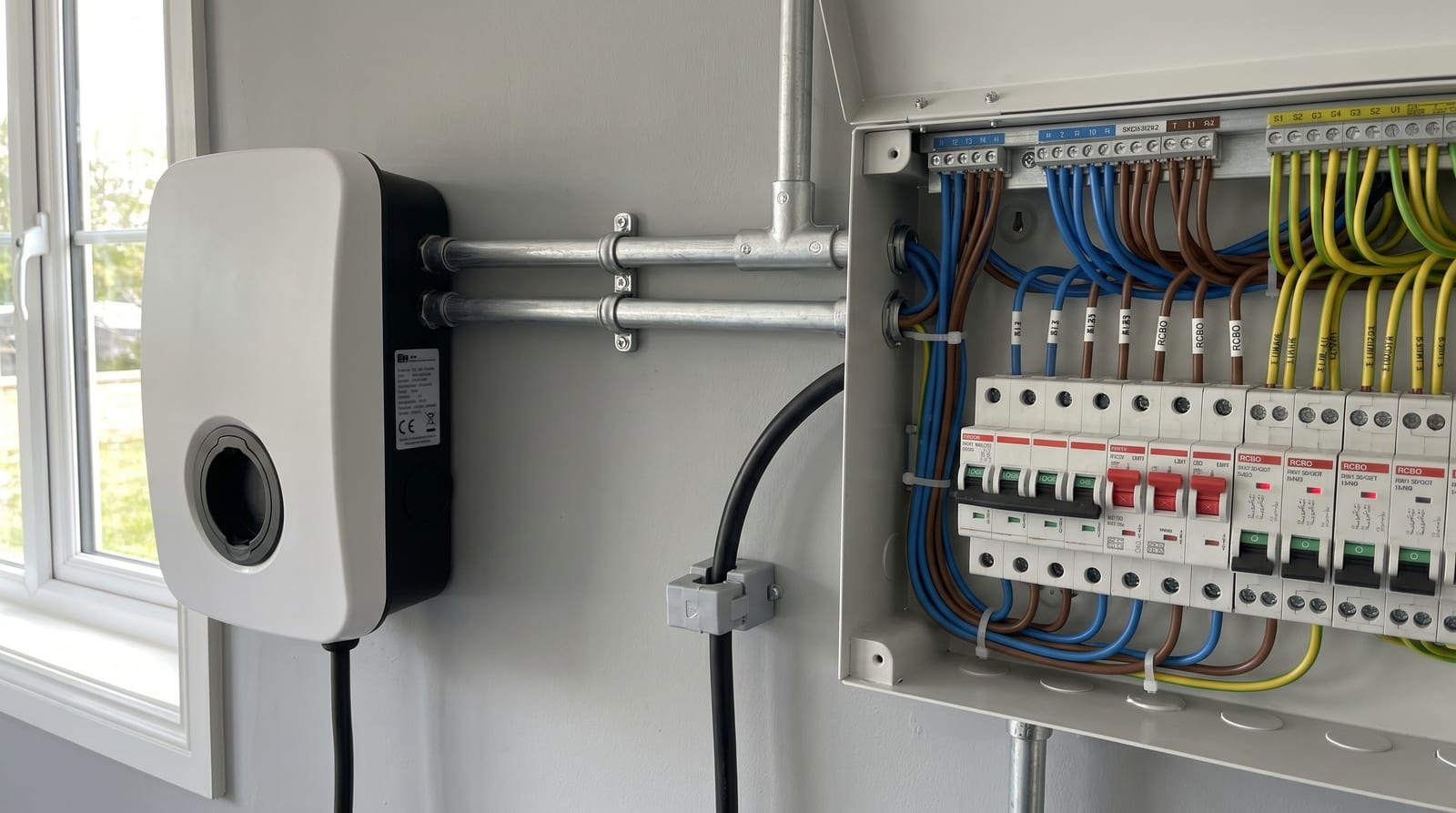
EV charger installations in the UK are regulated by a combination of electrical safety standards, smart charging regulations, and building regulations. For installers and clients alike, understanding the requirements protects against non-compliance risks that are easy to fall into and expensive to correct. This guide summarises the main requirements.
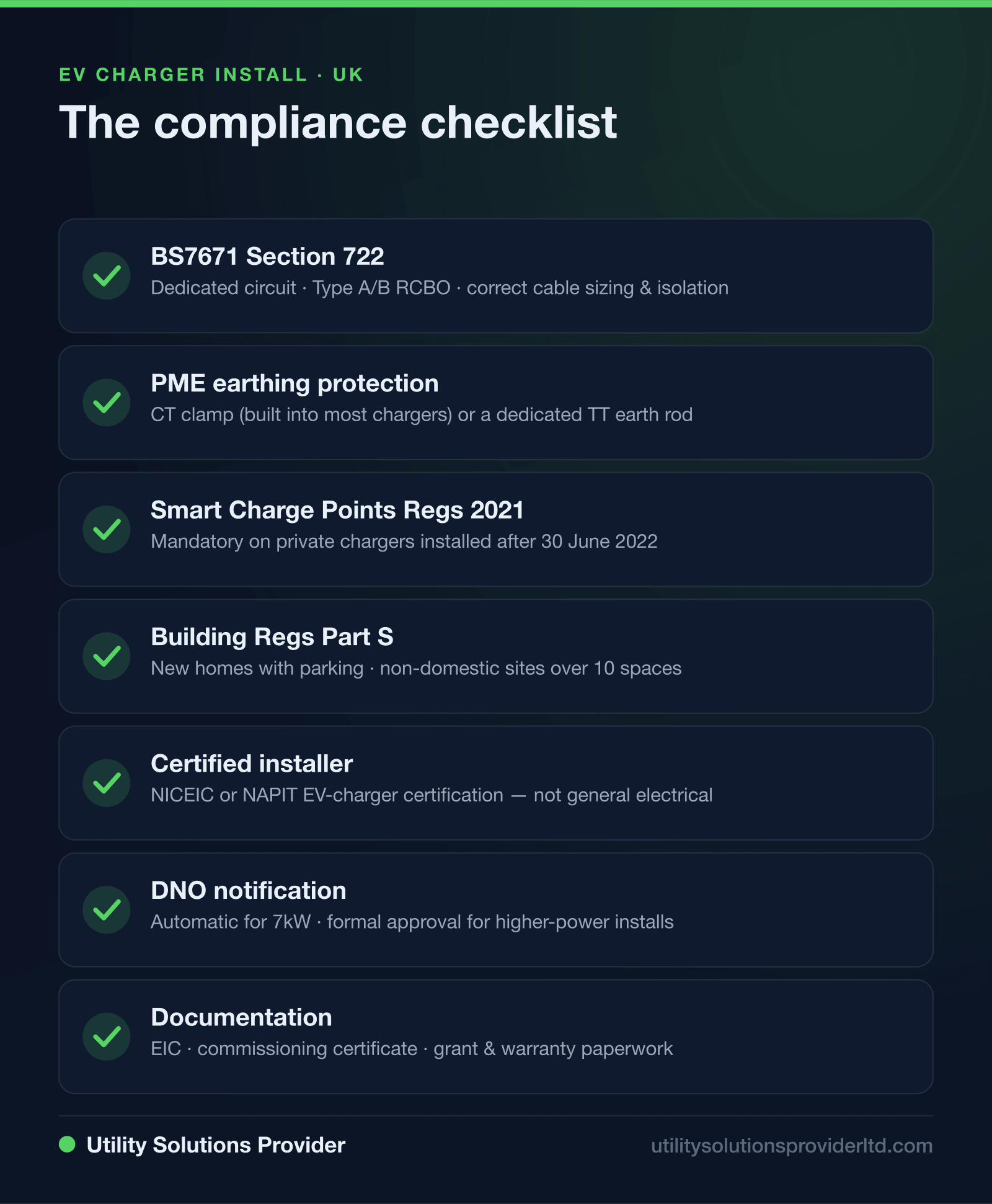
The compliance checklist for a UK EV charger installation.
BS7671: The Wiring Regulations
BS7671 (currently BS7671:2018+A2:2022, commonly called the 18th Edition) is the UK standard for electrical installations. Section 722 specifically covers EV charging installations.
Key requirements for EV chargers under BS7671 Section 722:
Each charger must be on a dedicated circuit from the consumer unit or distribution board.
Protection against electric shock is required, typically by a Type A or Type B RCBO. Type A is acceptable where the charger or cable itself provides 6mA DC fault current detection. Otherwise Type B is required.
Earthing must be provided, with specific provisions for PME supplies (the most common UK earthing arrangement).
Cables must be sized for the full charger rating including ambient conditions and any derating factors.
Isolation must be provided at an accessible location.
Signage must mark the circuit and its purpose.
Non-compliance with BS7671 can invalidate the installation’s Electrical Installation Certificate and may affect the property’s building insurance.
The PME Earthing Issue
The UK’s common PME (Protective Multiple Earthing) system creates specific complications for EV chargers.
Under PME, the earth connection is shared with the neutral. In rare fault conditions, the earth potential can become elevated, which on an EV charger means the car body could become live.
The regulatory solution is to provide one of:
A CT clamp on the incoming supply that detects PME faults and disconnects the charger.
A TT earth (separate earth rod) specific to the charger circuit.
A dedicated earth monitoring system.
Most modern chargers include CT clamp protection as standard. Check specifications carefully on older or budget chargers.
The Smart Charge Points Regulations 2021
The Electric Vehicle (Smart Charge Points) Regulations 2021 apply to all private EV chargers sold and installed in the UK.
Requirements include:
Smart functionality. Chargers must support scheduling, remote control, and energy monitoring.
Default off-peak charging. New chargers must default to charging during off-peak hours (typically 11am-2pm and 11pm-6am initially, with user override available).
Demand-side response capability. Chargers must be able to respond to grid signals.
Data security. Chargers must meet minimum cybersecurity standards.
User privacy. Data collection must comply with GDPR.
The regulations apply to private chargers only. Public and commercial chargers used purely for paid charging have separate requirements.
Chargers sold and installed after 30 June 2022 must comply with these regulations.
Building Regulations: Part S
Building Regulations Approved Document S (added in 2022) requires EV charge point provision for new buildings and major renovations.
Key requirements:
New homes with associated parking must have an EV charge point installed.
Residential buildings undergoing major renovation must have EV charge points provided where the parking is dedicated.
Non-residential buildings with more than 10 parking spaces must provide EV charge points or cable routes.
The specific numbers depend on building type and parking configuration. Part S is a meaningful cost item on new-build developments.
Installer Qualifications
EV charger installation is specialised work. The key qualification is:
NICEIC EV Charger Installer certification (or equivalent from another scheme such as NAPIT).
This certification requires formal training, assessment, and ongoing CPD. Installers who are not EV-certified should not carry out EV charger work, regardless of their general electrical qualifications.
For commercial and public chargers, additional qualifications may apply depending on the specific site and equipment.
DNO Notification
Most EV charger installations must be notified to the local DNO. The notification confirms:
The installation meets the technical requirements.
The supply can accommodate the new load.
The DNO has the information needed for network planning.
For single-phase 7kW chargers, notification is usually automatic through the installer’s portal and does not delay installation.
For higher-power installations or sites with multiple chargers, formal approval may be required before installation. Large installations may trigger a supply upgrade assessment.
Commercial Charger Compliance
Public and commercial chargers (those used by members of the public for paid charging) have additional requirements:
Public Charge Point Regulations 2023 (coming into force in stages) set standards for pricing transparency, payment methods, and uptime.
Contactless payment is required on all new public chargers over 8kW from late 2024.
Pricing must be displayed clearly before the charge begins.
Minimum uptime targets apply.
Reliability reporting is required for public charger operators.
These regulations are specifically for public charging and do not apply to private or restricted-access commercial chargers.
Fire Safety
Installing EV chargers in enclosed areas (multi-storey car parks, underground parking, covered parking) raises fire safety considerations:
Adequate ventilation.
Fire detection systems.
Fire suppression (in some cases).
Escape routes clear of charging equipment.
Signage for emergency services.
Building control input is essential for any EV charger installation in enclosed spaces.
Certification and Documentation
A compliant EV charger installation produces:
Electrical Installation Certificate (EIC) for the charger circuit.
DNO notification confirmation.
Commissioning certificate from the installer.
User documentation for the charger.
Grant claim documentation (if grant-funded).
Warranty documentation.
Keep all of this in one place. It is needed for insurance, for future servicing, and for grant audits.
Common Compliance Failures
Non-certified installers carrying out EV work. Creates invalidation risks and safety hazards.
Missing CT clamps on PME supplies. Creates a real electrical safety risk.
Oversized protective devices that don’t protect the cable correctly.
Missing DNO notification on higher-power installations.
Non-compliant chargers installed after June 2022 (not meeting Smart Charge Points Regulations).
Poor documentation making insurance claims or grant audits difficult.
The Bottom Line
EV charger installation is a regulated activity in the UK. The requirements are not unreasonable, but they are specific. Use a certified installer, choose compliant equipment, complete the paperwork properly, and keep the documentation safe. A compliant installation is safer, insurable, and stands up to any future scrutiny. A non-compliant installation may work fine today, but it creates real liabilities that surface exactly when you least want them to.